Solar Backup During Power Outages: A Practical Australian Guide
Solar backup during power outages can help households maintain access to essential electricity when the mains supply fails. However, having solar panels does not automatically mean your home will continue receiving electricity during a blackout.
The right solution depends on the solar equipment you already have, whether you need a home battery or portable power station, which appliances you want to keep running and how long the outage might last.
Some households need only enough backup power for phones, lighting and internet equipment. Others need to maintain refrigeration, medical equipment or a home office for several hours or longer.
This guide explains how solar backup works, the differences between rooftop solar and portable solar power, and how to plan a system around your household’s actual requirements.
If you are considering a portable unit, our portable power station buying guide explains the important specifications to compare before buying.
Table of Contents
What Does Solar Backup Mean During a Blackout?
Solar backup is a way to obtain electricity when the usual mains supply is unavailable. Depending on the equipment, it may involve rooftop solar panels, a home battery, a portable power station with solar charging or a dedicated off-grid system.
The key distinction is between generating electricity and having electricity available when you need it.
Solar panels generate electricity when suitable sunlight is available. A battery stores energy for later use. An inverter converts electricity into a form that compatible appliances can use.
A complete backup system needs the correct combination of equipment to provide power safely when the grid is unavailable.
For example, a household might have rooftop solar that reduces electricity bills during the day but does not provide blackout backup. Another household might have a solar-and-battery system specifically configured to keep selected circuits operating during an outage.
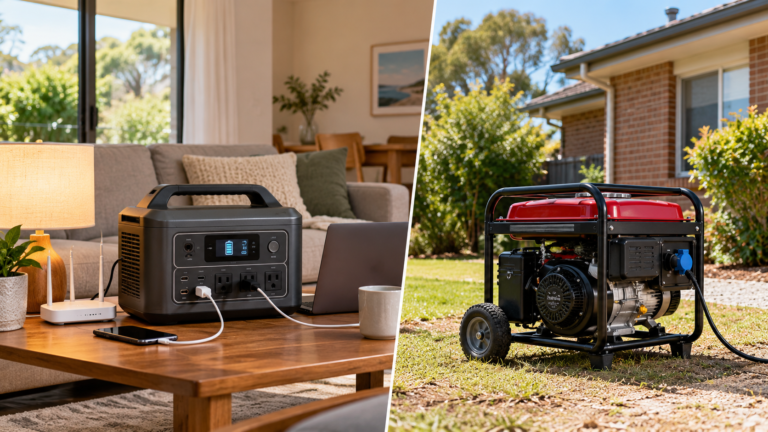
A portable power station offers a different approach. It stores electricity in its own battery and may be recharged using compatible solar panels, allowing selected appliances to operate independently of the home’s fixed electrical wiring.
The best arrangement depends on whether you want to protect a few essential devices or provide backup electricity to selected parts of your home.
Why Rooftop Solar May Switch Off During a Power Outage
One of the most important things to understand about solar backup during power outages is that ordinary grid-connected rooftop solar systems commonly shut down when the electricity grid fails.
This happens because grid-connected inverters are designed to stop exporting electricity when they detect a grid outage. The protection, known as anti-islanding, helps protect electricity workers and maintain safe operating conditions.
As a result, a sunny day does not necessarily mean your rooftop solar panels will keep your appliances running during a blackout.
A battery does not automatically solve the problem either. The complete installation must support backup operation, including the appropriate inverter, isolation equipment and configuration.
The Australian Government’s guidance on solar battery systems and backup supply explains the differences between ordinary grid-connected systems and systems designed to operate during outages.
Before assuming your existing solar installation will provide emergency power, ask your installer to confirm:
- Whether your system supports backup operation.
- Which appliances or circuits can receive backup electricity.
- Whether the system can recharge its battery during an outage.
- How long the battery is expected to supply your essential loads.
- What happens when the battery becomes depleted.
- Whether the system needs additional equipment or electrical work.
Understanding these limitations before an emergency is much better than discovering them when the lights go out.
Three Ways to Get Solar Backup
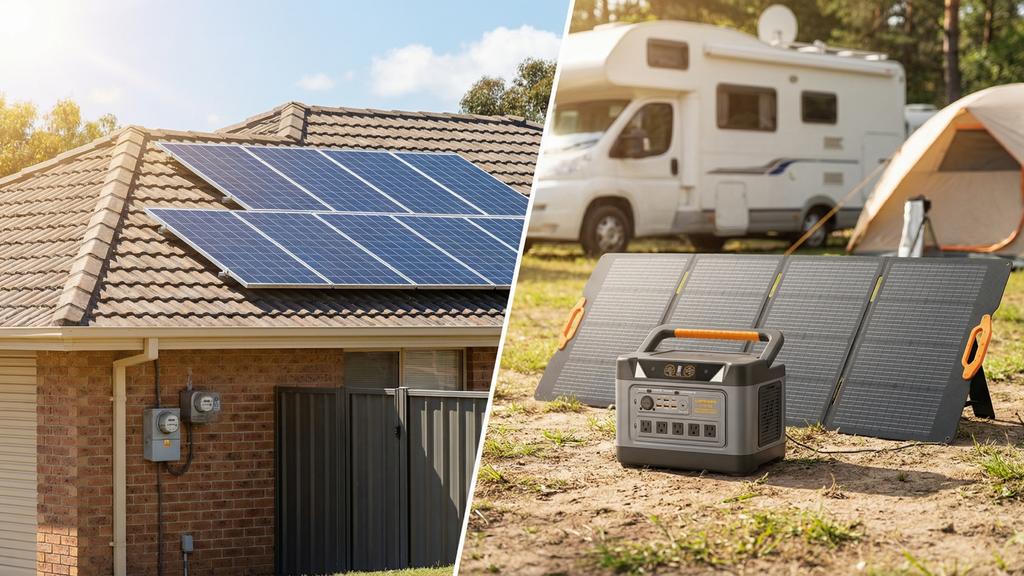
There is no single solar backup solution that suits every Australian household. Three common approaches are worth considering.
1. Rooftop Solar With a Backup-Enabled Home Battery
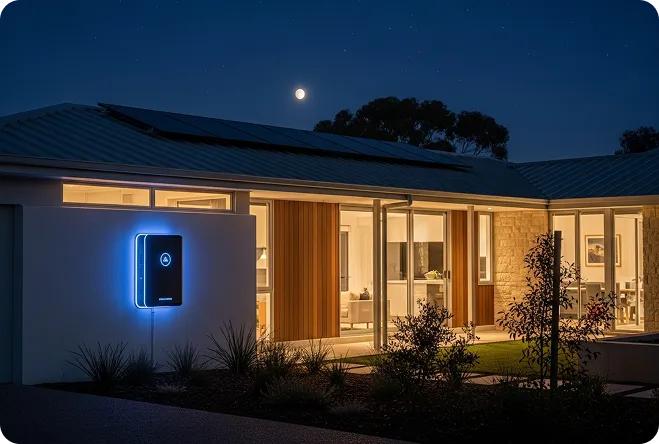
A properly designed solar-and-battery system can store excess electricity generated during the day and use that stored energy when solar production falls or the grid fails.
For blackout protection, the system must have the necessary backup capability. Depending on its design, it may power selected essential circuits or provide broader backup for the property.
Potential advantages include:
- Using stored solar energy after sunset.
- Maintaining selected essential appliances during an outage.
- Recharging the battery from solar when suitable conditions return.
- Integrating backup operation into the home’s electrical system.
The limitations depend on the installation.
A battery may not support every circuit in the house. Its inverter may have limits on the amount of power it can supply at one time. A long period of cloudy weather can also restrict how much energy can be replenished.
This option is worth investigating if you already have rooftop solar and want a more integrated backup solution.
Ask a suitably qualified and accredited installer to assess your existing system, electricity usage, essential loads and required backup duration.
2. A Portable Power Station With Solar Panels
A portable power station is a rechargeable battery unit that can operate compatible appliances through its available AC, USB or DC outputs.
Many models also accept solar charging through compatible panels.
This arrangement can be attractive if you want backup power for selected devices without installing a permanent home battery.
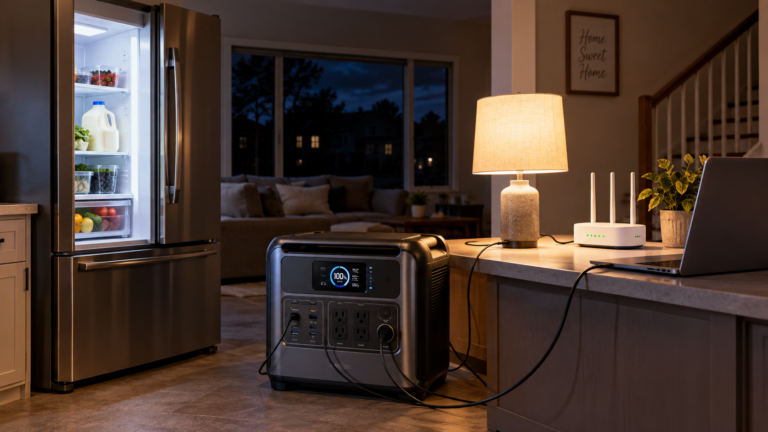
Depending on its capacity and power output, a portable power station may support:
- Phones and tablets.
- LED lighting.
- Wi-Fi routers and compatible networking equipment.
- Laptops and selected computer equipment.
- Televisions.
- Some refrigerators or camping fridges.
- Selected medical or mobility-related equipment, subject to the equipment manufacturer’s requirements.
Not every power station can operate every appliance. High-power devices and appliances with motors or compressors may require substantial continuous or starting power.
Battery capacity also determines how much energy is stored for use over time.
A portable power station is therefore best selected by calculating the appliances you want to run, the energy they will consume and the output the equipment requires.
Our guide to the best portable power station for home backup provides a starting point for comparing options.
3. A Dedicated Off-Grid Solar System
Some households, sheds, remote properties and off-grid buildings use solar panels with battery storage and equipment designed to operate independently of the electricity grid.
These systems are different from ordinary grid-connected rooftop solar because they are designed around independent power generation and storage.
An off-grid system needs to be sized for the expected energy consumption, seasonal solar conditions, battery storage and the appliances that will operate at the same time.
It may also require alternative charging or generation arrangements when solar production is insufficient.
This approach can be appropriate for properties that are not connected to the electricity grid or have substantial independent power requirements. It is generally more involved than purchasing a portable power station for a few essential devices.
For a typical household that only wants short-term backup during occasional blackouts, a complete off-grid installation may be unnecessary.
Which Appliances Should You Keep Running?
During a blackout, it helps to decide which appliances are essential before choosing a backup system.
Trying to power everything in the house can quickly increase the amount of battery capacity and output you need.
Consider dividing appliances into three groups.
Essential equipment
These are the devices you most need to maintain during an outage.
Examples may include:
- Phones and communications equipment.
- Essential lighting.
- Internet equipment, where the local network service remains available.
- Refrigeration for food and necessary supplies.
- Essential medical equipment.
- Equipment needed for work or other important daily activities.
Medical equipment should only be powered using a setup confirmed suitable by the equipment manufacturer or your healthcare provider.
Useful but non-essential equipment
This group might include a television, laptop used for general purposes, small fans or other devices that improve comfort.
These appliances may be worth powering when sufficient capacity is available, but you may choose to limit their use during a prolonged outage.
High-demand appliances
Kettles, microwaves, heaters, cooktops and some other household appliances can use substantial power.
Adding these appliances may significantly increase the required inverter output and energy consumption. Some devices may be unsuitable for a particular portable power station, even when its battery appears large enough.
Start with your essential equipment and build the backup plan around that list.
How to Estimate the Battery Capacity You Need
Choosing solar backup during power outages becomes easier when you estimate how much energy your equipment will consume.
Battery capacity is measured in watt-hours (Wh) or kilowatt-hours (kWh). Power output is measured in watts (W) or kilowatts (kW).
For individual appliances, a basic energy estimate is:
Energy required in Wh = appliance power in W × operating time in hours
For example, a 50W device operating for four hours would theoretically use:
50W × 4 hours = 200Wh
Repeat the calculation for each device and add the results together.
For equipment that cycles on and off, such as a refrigerator, use reliable energy-consumption information where possible rather than assuming it continuously operates at its maximum rated wattage.
Allow for usable capacity and losses
The battery’s advertised capacity is not necessarily the amount of electricity that reaches your appliances.
The available energy depends on the equipment, conversion losses, battery reserve settings and operating conditions.
For illustration, suppose your essential appliances are expected to consume 1,200Wh during the period you want to cover. If you assumed that 85% of the nominal battery capacity would be available for your appliances, the calculation would be:
1,200Wh ÷ 0.85 = approximately 1,412Wh
This is only an illustrative calculation, not a universal efficiency rating or a guarantee of runtime. Use the manufacturer’s specifications and allow an appropriate margin when planning an actual system.
The required battery size will increase if you want to cover more appliances or extend the backup period.
For more detail, see our guide to what size power station you need.
How Much Solar Panel Capacity Do You Need?
Solar panels can replenish a compatible battery during daylight, but the amount of energy produced varies with sunlight, shading, panel orientation, weather and equipment limitations.
A panel’s advertised wattage describes its rated power under specified test conditions. It does not tell you exactly how many watt-hours it will produce in an ordinary day.
An illustrative estimate is:
Solar energy = panel wattage × equivalent peak-sun hours × planning factor
For example, a 400W panel using an illustrative three peak-sun hours and a planning factor of 0.70 would give:
400W × 3 hours × 0.70 = 840Wh
This is a planning example, not a prediction for a particular Australian location or day.
Actual output can be lower, particularly during cloudy conditions or when panels are shaded. The planning factor is included to illustrate that real-world production is below the simple maximum calculation.
Check the manufacturer’s solar-input limits, permitted voltage range, connector compatibility and maximum solar charging power before selecting panels for a power station.
For a fixed rooftop system, your installer can assess expected generation, battery requirements and backup operation for your property.
How to Choose the Right Setup for Your Home
The most suitable backup solution depends on your household and how outages affect you.
Consider how long an outage might last
A short interruption may require only phones, lights and networking equipment. A longer outage may require refrigeration, additional lighting, more communications equipment and a way to replenish stored energy.
Decide which loads are essential and estimate how long you need to power them.
Check continuous and surge output
Battery capacity is only part of the decision.
Your backup system must also supply enough power for the equipment that will be operating at the same time.
Motors and compressors may need additional power when starting. Check appliance and system specifications instead of relying on general estimates.
Think about recharging
If you have a fixed solar-and-battery installation, confirm whether solar generation can continue during an outage and whether the system can replenish the battery.
With a portable power station, consider compatible solar panels, mains charging when electricity is available and any other charging options supported by the manufacturer.
Consider installation and portability
A fixed home battery may suit a household seeking integrated electrical backup. A portable power station may suit someone who wants to move the unit, take it camping or power selected devices directly.
These are different applications. A portable power station should not be assumed to replace a professionally installed home backup system.
Check the complete specifications
Before purchasing, compare:
- Usable battery capacity.
- Continuous output rating.
- Surge or peak output, where applicable.
- Charging options.
- Solar input requirements.
- Supported appliances.
- Expansion capability.
- Warranty and Australian support.
- Installation requirements, where applicable.
The goal is to select the simplest system that meets your actual needs rather than automatically buying the largest or most expensive option.
Safety Considerations for Solar Backup
Electrical backup equipment needs to be used according to its manufacturer’s instructions and Australian electrical requirements.
A portable power station is generally intended to power compatible devices through its designated outlets. Do not connect it to household wiring or attempt to feed electricity back into a wall socket.
Connecting backup equipment to fixed household circuits requires an appropriate system design and installation by a licensed electrician.
Other important precautions include:
- Use only compatible chargers, solar panels and cables.
- Keep portable equipment protected from rain and moisture unless its rating explicitly permits the conditions.
- Follow the manufacturer’s ventilation, temperature and storage instructions.
- Inspect cables and plugs for damage before use.
- Do not overload the power station or inverter.
- Keep equipment away from children, water and other hazards.
- Follow the operating and charging instructions for lithium-ion batteries.
- Arrange a suitable backup plan for essential medical equipment rather than assuming any general-purpose battery will be suitable.
For a fixed home battery, use an appropriately accredited installer and follow the installation and maintenance guidance supplied with the equipment.
The Queensland Government’s home battery system guide provides additional guidance for households considering a battery system.
Common Solar Backup Mistakes to Avoid
Assuming rooftop solar automatically works in a blackout
Many grid-connected systems shut down during grid failures. Confirm your installation’s actual backup capability.
Buying a battery based only on its capacity
A large battery may still have insufficient output for your appliances. Check continuous and starting power requirements.
Ignoring how the battery will recharge
Stored energy will eventually be depleted. Consider what will happen if the outage continues and solar production is low.
Trying to power the entire home unnecessarily
Prioritising essential loads may allow a smaller and less expensive solution to meet your needs.
Assuming solar panels will produce their rated power all day
Panel output varies with conditions. Build your plan around realistic energy production rather than the maximum rating printed on the panel.
Leaving electrical changes until an outage occurs
If you want backup through your existing home electrical circuits, discuss the design with an appropriate electrician or solar installer before a blackout happens.
A Solar Backup Preparation Checklist
Use this checklist to prepare your household before the next power interruption.
- Identify the appliances and devices you consider essential.
- Estimate their wattage and expected operating time.
- Calculate your approximate energy requirement in Wh or kWh.
- Check the system’s battery capacity and usable energy.
- Confirm the continuous output and surge requirements.
- Determine whether your rooftop solar will operate during an outage.
- Confirm whether any home battery is configured for backup.
- Check compatible solar charging options.
- Consider what happens during cloudy weather or an extended outage.
- Test your backup equipment according to the manufacturer’s instructions.
- Keep charging cables, manuals and necessary accessories accessible.
- Arrange an appropriate backup plan for essential medical equipment.
- Keep contact details for your installer and equipment manufacturer.
Preparing ahead of time makes it easier to make sensible decisions when the power supply fails.
Frequently Asked Questions
Will rooftop solar work during a blackout?
Not necessarily. Many grid-connected solar systems shut down when the grid fails for safety reasons. A system needs suitable equipment and configuration to provide backup during an outage.
Can solar panels charge a battery during a power outage?
Yes, in a properly configured system with compatible equipment. A backup-enabled home solar-and-battery system may continue generating and storing energy when conditions allow. A portable power station may also accept charging from compatible solar panels.
Is a home battery better than a portable power station?
Neither is universally better. A home battery can be part of an integrated backup installation, while a portable power station can be convenient for powering selected appliances directly. The right choice depends on capacity, output, portability, installation requirements and the loads you need to support.
How long will solar backup last?
It depends on usable battery capacity, the electricity consumption of your appliances, solar generation and how much energy can be replenished. An effective plan considers both stored energy and the likely availability of additional charging.
Our guide explains how long a portable power station will run and why theoretical runtime calculations may differ from real-world results.
Can a portable power station run a refrigerator during a blackout?
Some can, provided the station has enough continuous output, sufficient starting capability and enough usable battery energy for the required runtime. Check the refrigerator and power station specifications before connecting them.
Do I need solar panels if I already have a battery?
Not necessarily for short-term backup if the battery is already charged. Solar panels can help replenish compatible batteries when sunlight is available, which may be useful during longer outages. The suitability depends on the system and its charging capabilities.
Should I buy the largest battery I can afford?
Not automatically. Start with your essential appliances, estimate their energy use and check the power output you need. Choose a system that covers those requirements with a sensible margin rather than paying for capacity you may not use.
Final Thoughts
Solar backup during power outages can provide useful protection against interruptions to the electricity supply, but the right arrangement depends on how the system is designed and what you expect it to power.
Rooftop solar, home batteries and portable power stations have different capabilities. Ordinary grid-connected solar may shut down during an outage, and a battery only provides backup when the complete installation supports that function.
Start by identifying your essential appliances, estimating their energy consumption and checking both the output and usable capacity of the proposed system. Then consider how the battery will be recharged if the outage continues.
The most practical solution is the one that safely keeps your essential equipment operating for the period you need, with realistic expectations about available energy and charging conditions.
Preparing before a blackout gives you a better chance of choosing a suitable backup system without paying for equipment that does not match your household’s needs.