How Long Will a Portable Power Station Run? A Complete Runtime Guide
How long will a portable power station run? The answer depends on the power station’s battery capacity, the amount of electricity your appliances use and how long you need to run them.
A power station with a large battery can provide many hours of power for low-demand devices, while a high-wattage appliance can use the stored energy much more quickly. The advertised battery capacity is also not the same as the amount of energy that will actually reach your appliances because some energy is lost during conversion.
The easiest way to estimate runtime is to look at both watts and watt-hours. Watts tell you how much power an appliance uses while operating, while watt-hours describe how much energy the battery can store.
In this guide, we explain how to calculate portable power station runtime, why real-world runtime differs from simple calculations, and how long different battery sizes may run common appliances such as televisions, refrigerators, laptops, lights, kettles and microwaves.
Table of Contents
How Portable Power Station Runtime Works
A portable power station stores electrical energy in its battery and then converts that stored energy into power that can be used by connected devices.
How long the power station will run depends mainly on three things: how much energy the battery stores, how much power the connected equipment uses and how efficiently the stored energy is converted into usable electricity.
This means a power station with a large battery does not automatically provide a long runtime for every appliance.
A low-power device such as a phone charger, LED light or Wi-Fi router may operate for many hours, while a high-power appliance such as a kettle, microwave or heater can use the available energy much faster.
Battery capacity matters
Battery capacity is normally expressed in watt-hours (Wh).
A higher Wh rating means the battery stores more energy, all else being equal.
For example, a 2,000Wh power station stores roughly twice as much nominal battery energy as a 1,000Wh model.
That does not mean every appliance will run for exactly twice as long, because actual runtime also depends on the appliance, conversion losses and the operating conditions.
Appliance power matters too
Appliance power is normally expressed in watts (W).
A device using 50W consumes energy much more slowly than one using 1,000W.
For example, a 50W device operating for 10 hours would theoretically use:
50W × 10 hours = 500Wh
A 1,000W appliance would reach the same theoretical energy consumption in only 30 minutes:
1,000W × 0.5 hours = 500Wh
This is why looking at battery capacity without considering appliance wattage can give a misleading impression of runtime.
Not every appliance consumes power in the same way
Some equipment uses relatively steady power while operating.
Other appliances cycle on and off or change their power demand.
Refrigerators are a good example. The compressor may run for part of the time rather than continuously drawing its maximum rated power.
Motors and compressors can also require additional power when starting.
For runtime planning, it is therefore useful to consider both the appliance’s expected energy consumption and its starting requirements.
Runtime is an estimate, not a fixed number
Manufacturers may quote battery capacity and other specifications under particular test conditions.
Actual runtime can vary depending on the appliance, temperature, battery condition, power conversion, connected loads and the way the power station is being used.
The most useful approach is therefore to calculate an estimated runtime and then allow a sensible margin rather than treating the mathematical result as a guarantee.
The Basic Runtime Formula
The simplest way to estimate portable power station runtime is to divide the available battery energy by the power being consumed.
For additional background on energy, power and electricity use, you can also refer to Australian Government energy guidance.
The basic formula is:
Runtime in hours = battery capacity in Wh ÷ appliance power in W
For example, suppose a power station has a nominal battery capacity of 1,000Wh and you connect an appliance using 100W.
The simple calculation is:
1,000Wh ÷ 100W = 10 hours
This is a theoretical result.
In real use, the appliance will normally run for less time because not all of the nominal battery capacity reaches the appliance.
A second example
Suppose the same 1,000Wh power station is connected to a 250W appliance.
1,000Wh ÷ 250W = 4 hours
Again, this assumes that the entire battery capacity could be delivered to the appliance with no losses.
Actual runtime will generally be lower.
Why the formula is still useful
The formula provides a quick way to compare different battery sizes and appliance loads.
For example:
500Wh ÷ 100W = 5 hours
1,000Wh ÷ 100W = 10 hours
2,000Wh ÷ 100W = 20 hours
These are theoretical comparisons rather than guaranteed operating times, but they demonstrate how battery capacity affects potential runtime.
Multiple appliances require a different calculation
If several appliances are running at once, first determine their combined power requirement.
For example:
Television: 100W
Laptop: 60W
LED lighting: 20W
Combined load:
100W + 60W + 20W = 180W
A 1,000Wh battery divided by 180W gives:
1,000Wh ÷ 180W = approximately 5.6 hours
That is still only a theoretical result.
The actual runtime depends on the power station’s usable energy, conversion efficiency and the behaviour of the connected appliances.
AC and DC loads can behave differently
A device connected through the power station’s AC inverter may have different losses from a device supplied through a DC or USB output.
For this reason, two devices with the same nominal wattage can sometimes produce different real-world battery runtimes depending on how they are connected.
Use the manufacturer’s information where it is available, particularly when planning for equipment that needs to run for many hours.
Why Battery Capacity Isn’t the Same as Usable Energy
The battery capacity printed on a power station describes the amount of energy stored in the battery under the manufacturer’s specified conditions.
It does not necessarily mean that the full advertised capacity will be available to your appliance.
There are several reasons for this.
Conversion losses
When battery energy is converted into AC electricity, some energy is lost during the conversion process.
The power station also uses a small amount of energy for its own electronics, display, battery management and other functions.
As a result, the energy delivered to an appliance can be lower than the nominal battery capacity.
The battery rating is not a guaranteed runtime figure
A 1,000Wh battery should not be interpreted as meaning:
“This power station will always provide 1,000Wh to my appliances.”
Instead, the Wh figure is best treated as the battery’s nominal stored-energy capacity.
The amount actually available at the output depends on the particular power station and the way it is being used.
Operating conditions can affect results
Actual performance can vary with factors such as:
- the connected load
- ambient temperature
- battery condition
- inverter efficiency
- power station settings
- the type of output being used
For that reason, a calculated runtime should be treated as an estimate.
Allow a sensible margin
When sizing a power station, avoid choosing a battery whose nominal capacity exactly matches your calculated energy requirement.
For example, if your equipment theoretically requires 800Wh, selecting a power station rated at exactly 800Wh leaves little room for conversion losses or changes in your actual usage.
A somewhat larger battery provides a useful margin.
The amount of extra capacity you need will depend on the power station and your particular application.
Usable energy is what matters to you
For practical planning, the important question is not simply:
“How many watt-hours does the battery contain?”
The more useful question is:
“How much energy can this particular power station realistically deliver to my equipment?”
Where a manufacturer provides a usable-energy figure or expected runtime information, use that information when available.
Otherwise, start with the nominal Wh rating, calculate your expected energy requirement and then allow for real-world losses.
The same battery can provide very different runtimes
Consider a 1,000Wh power station.
A 50W load might theoretically require:
1,000Wh ÷ 50W = 20 hours
A 500W load would theoretically require:
1,000Wh ÷ 500W = 2 hours
The battery has not changed.
The difference comes from the amount of power being consumed by the connected equipment.
This is why battery capacity and appliance power must always be considered together.
How Inverter Efficiency Affects Runtime
A portable power station may need to convert the battery’s stored energy into AC electricity before it can power an appliance.
That conversion is not perfectly efficient.
Some energy is lost as heat and through the operation of the power electronics.
Why this matters
Suppose a battery contains 1,000Wh of nominal stored energy.
A connected AC appliance does not necessarily receive the full 1,000Wh.
The exact amount available depends on the power station’s design, conversion efficiency and its own operating consumption.
This means a simple calculation such as:
1,000Wh ÷ 100W = 10 hours
should be treated as a theoretical maximum rather than a guaranteed runtime.
Low-power loads can be affected by overhead
Another consideration is the power station’s own operating consumption.
If a small device is connected for a long period, the power station may still consume energy to operate its inverter and electronics.
This can make the difference between theoretical and real-world runtime more noticeable with some low-power loads.
AC versus DC operation
Some portable power stations provide several different output options, including AC outlets, USB ports and DC outputs.
Using an output that avoids unnecessary conversion may improve overall efficiency for certain compatible devices.
However, the exact benefit depends on the equipment and the power station.
Never use an alternative connection simply because it appears more efficient. The voltage, current and connector must be compatible with the equipment and approved for that use.
Use manufacturer information where possible
If the manufacturer provides efficiency figures, expected runtimes or energy-delivery information, use those figures when estimating performance.
Manufacturer specifications for the exact model are more useful than applying one generic efficiency percentage to every power station.
The practical takeaway
When estimating how long a portable power station will run, use the basic Wh ÷ W formula as your starting point.
Then allow for:
Conversion losses
The power station’s own consumption
Changes in appliance power demand
Battery and operating conditions
This produces a more realistic estimate than assuming the nominal battery capacity is fully available to the appliance.
How Long Will a Portable Power Station Run Common Devices?
The runtime of a portable power station depends heavily on the appliance or device connected to it. A small electronic device may use only a few watts, while a heating appliance can require more than 1,000 watts.
The examples below are intended to show how the calculation works rather than provide guaranteed runtimes for every product.
Your actual result will depend on the appliance’s power consumption, the power station’s usable battery capacity, conversion losses and the way the device operates.
Before estimating runtime, it is also useful to understand what a portable power station can run and which appliances require the most power.
Phones and tablets
Phones and tablets are among the easiest devices to run from a portable power station because they generally require relatively little energy.
A phone charger might draw around 10–30W while charging, although the actual power consumption varies according to the device, charger and charging stage.
For example, a 1,000Wh power station supplying a 20W load gives a theoretical calculation of:
1,000Wh ÷ 20W = 50 hours
That does not mean a phone would literally charge continuously for 50 hours.
A phone normally reaches full charge and then stops drawing the same level of power. The useful point is that the energy requirement is small compared with that of a high-power appliance.
Laptops
Laptops can also run for many hours from a suitable power station.
Suppose a laptop and its charger consume an average of 60W while operating.
A 1,000Wh battery would theoretically provide:
1,000Wh ÷ 60W = approximately 16.7 hours
Actual runtime will be lower after allowing for conversion losses and the power station’s own consumption.
Laptop power use can also change depending on the screen brightness, processor activity, charging state and applications being used.
Televisions
Television power consumption varies considerably between models and screen sizes.
As an illustration, suppose a television uses 100W.
A 1,000Wh power station gives:
1,000Wh ÷ 100W = 10 hours
A 2,000Wh power station gives:
2,000Wh ÷ 100W = 20 hours
These are theoretical figures.
Actual runtime depends on the television’s real power consumption and the efficiency of the power station.
Wi-Fi routers and networking equipment
A Wi-Fi router usually requires much less power than a television or cooking appliance.
Suppose a router and associated networking equipment consume 15W.
The theoretical runtime from a 1,000Wh battery would be:
1,000Wh ÷ 15W = approximately 66.7 hours
Again, the real result will depend on conversion losses and the actual power consumption of the networking equipment.
Because networking equipment can operate for many hours, relatively small power stations can sometimes provide useful backup power for an internet connection during an outage.
Lights and fans
LED lighting generally requires relatively little electricity compared with heating appliances.
For example, a 20W lighting load from a 1,000Wh battery would give a theoretical runtime of:
1,000Wh ÷ 20W = 50 hours
A fan may use more power, depending on its size, motor and speed setting.
Suppose a fan uses 50W:
1,000Wh ÷ 50W = 20 hours
These examples show why low-power appliances can often operate for extended periods from a moderately sized battery.
Refrigerators
Refrigerators need more careful planning because their compressors cycle on and off and may require additional power when starting.
You should not simply divide the battery capacity by the refrigerator’s maximum running wattage and assume that this will represent the actual runtime.
Instead, check the refrigerator’s energy-consumption information wherever possible.
For example, if a refrigerator uses an average of 80W over the period being considered, a 1,000Wh battery would give a simple theoretical result of:
1,000Wh ÷ 80W = 12.5 hours
The actual runtime could be different because compressor cycling, startup demand, ambient temperature and power-conversion losses all affect the result.
For refrigerators, the power station must also have enough continuous AC output and surge capability to handle the compressor.
Kettles
Electric kettles are very different from routers and lights because they can draw a high amount of power while operating.
A kettle may use around 1,500W or more, depending on the model.
Suppose a 1,500W kettle operates for 10 minutes.
Ten minutes is one-sixth of an hour, or approximately 0.167 hours.
The theoretical energy use is:
1,500W × 0.167 hours = approximately 250Wh
This means a 1,000Wh battery could theoretically supply several such short heating cycles.
However, the kettle’s high power demand means you must check the power station’s continuous AC output before using it.
A power station with a large battery but insufficient output may not be able to operate the kettle.
Microwaves
Microwave ovens can also have substantial power requirements.
The power stated for a microwave can refer to its cooking output rather than the total electrical input, so check the manufacturer’s specifications carefully.
Suppose a particular microwave draws 1,200W from the power supply and operates for 10 minutes.
The theoretical energy consumption would be:
1,200W × 0.167 hours = approximately 200Wh
That is a relatively small amount of total energy compared with the full capacity of a large battery, but the instantaneous power demand is high.
The power station therefore needs sufficient continuous output to operate the microwave safely within its specifications.
Air fryers and cooking appliances
Air fryers, hotplates, toasters and other cooking appliances can place a substantial load on a portable power station.
Their operating time may be relatively short, but their wattage can be high.
For example, a 1,500W appliance operating for 20 minutes would theoretically use:
1,500W × 0.333 hours = approximately 500Wh
A 1,000Wh power station therefore cannot be expected to operate a 1,500W appliance continuously for several hours.
It may have enough total energy for shorter cooking sessions, provided its output rating is high enough.
Power tools
Power tools vary significantly.
Cordless tools can be charged from a portable power station, while corded tools may require substantially more power.
Tools with motors can also have higher startup requirements.
Check the manufacturer’s electrical specifications and compare both the normal operating load and the startup or surge requirements with the power station’s output.
CPAP machines
A CPAP machine can often be operated from a suitable portable power station, but runtime depends on the particular CPAP model, pressure settings, humidifier use and whether the machine is connected through AC, DC or another compatible power arrangement.
For overnight use, calculate the energy requirement for the entire expected sleeping period rather than choosing a battery based only on the machine’s apparent running wattage.
Where the manufacturer provides a battery-runtime recommendation or power-consumption figure, use that information.
Heaters
Electric heaters are among the most demanding common household appliances.
A heater can consume around 1,000W, 1,500W or more depending on the model and setting.
A 1,500W heater operating for one hour would theoretically use:
1,500Wh
That means a 1,000Wh power station would not provide one hour of operation at that load, even before accounting for conversion losses.
High-power heating appliances therefore require both a large enough battery and a power station with sufficient output.
The important difference between runtime and compatibility
These examples demonstrate an important point.
A power station can have enough battery capacity to store the energy required by an appliance but still be unable to run it because its inverter cannot supply sufficient continuous power.
The opposite can also happen.
A power station may have enough output to operate an appliance but not enough battery capacity to operate it for the desired length of time.
Before choosing a power station, check both requirements.
Typical Runtime Examples
| Device or Appliance | Example Power | 1,000Wh Theoretical Runtime |
|---|---|---|
| Wi-Fi router | 15W | 66.7 hours |
| LED lighting | 20W | 50 hours |
| Laptop | 60W | 16.7 hours |
| Television | 100W | 10 hours |
| Refrigerator* | 80W average | 12.5 hours |
| Fan | 50W | 20 hours |
| Microwave | 1,200W | 50 minutes |
| Kettle | 1,500W | 40 minutes |
| Heater | 1,500W | 40 minutes |
*Refrigerator runtime is especially difficult to estimate from wattage alone because compressor operation cycles on and off.
These figures are theoretical calculations based on the example power figures shown, not guaranteed real-world runtimes.
Actual runtime will generally be lower because of conversion losses, the power station’s own consumption and changes in appliance power demand.
How Long Will a 500Wh Power Station Run?
A 500Wh portable power station can be useful for smaller electrical loads, short trips, emergency charging and lightweight camping.
The actual runtime depends on the appliance connected to the power station.
For example, using the simple theoretical formula:
500Wh ÷ 50W = 10 hours
So a 50W device would have a theoretical runtime of around 10 hours from a 500Wh battery.
A 100W device would give:
500Wh ÷ 100W = 5 hours
A 500W device would give:
500Wh ÷ 500W = 1 hour
These figures are theoretical and do not account for conversion losses or the power station’s own consumption.
What a 500Wh power station may be suitable for
A 500Wh model may be useful for:
- phones and tablets
- laptops
- LED lighting
- Wi-Fi routers
- small fans
- cameras and other electronics
- short camping trips
It can also provide useful backup for selected devices during a power outage.
High-power appliances require much more careful planning. A kettle, microwave, heater or other heating appliance may use a large portion of the available stored energy in a relatively short period.
The power station must also have sufficient continuous AC output to operate the appliance.
A practical 500Wh example
Imagine you want to use a laptop drawing 60W for five hours.
The theoretical energy requirement is:
60W × 5 hours = 300Wh
That leaves a theoretical 200Wh from the 500Wh battery before allowing for conversion losses and other energy use.
The real runtime will therefore be lower than the simple calculation suggests.
A 500Wh power station can be a sensible choice when portability is more important than very long runtime and your electrical demands are relatively modest.
How Long Will a 1,000Wh Power Station Run?
A 1,000Wh portable power station provides approximately twice the nominal battery capacity of a 500Wh model, so it can provide considerably more stored energy when used with the same appliance.
For a 50W load:
1,000Wh ÷ 50W = 20 hours
For a 100W load:
1,000Wh ÷ 100W = 10 hours
For a 500W load:
1,000Wh ÷ 500W = 2 hours
For a 1,000W load:
1,000Wh ÷ 1,000W = 1 hour
Again, these are theoretical calculations rather than guaranteed runtimes.
What a 1,000Wh power station may be suitable for
A 1,000Wh model can be useful for:
- longer camping trips
- caravan use
- home-office backup
- televisions
- laptops and computers
- networking equipment
- lighting
- fans
- selected refrigerators
- short periods of higher-power appliance use
The exact appliances you can operate depend on the power station’s output rating as well as its battery capacity.
Example: television and networking equipment
Suppose a television uses 100W and a Wi-Fi router uses 15W.
The combined load is:
100W + 15W = 115W
The theoretical runtime from a 1,000Wh battery is:
1,000Wh ÷ 115W = approximately 8.7 hours
The actual runtime will be shorter because of conversion losses and other factors.
This example demonstrates why calculating the combined load is important when more than one device will operate at the same time.
Is 1,000Wh enough?
For many people, 1,000Wh is a useful middle ground between portability and stored energy.
It provides considerably more capacity than a small 300–500Wh unit without necessarily requiring the size and weight of a much larger home-backup system.
However, your actual requirements should determine the size you choose.
How Long Will a 2,000Wh Power Station Run?
A 2,000Wh portable power station provides substantially more stored energy and can be useful when you need longer runtime or want to operate several moderate-power devices.
Using the simple theoretical calculation:
2,000Wh ÷ 50W = 40 hours
For a 100W load:
2,000Wh ÷ 100W = 20 hours
For a 500W load:
2,000Wh ÷ 500W = 4 hours
For a 1,000W load:
2,000Wh ÷ 1,000W = 2 hours
For a 1,500W load:
2,000Wh ÷ 1,500W = approximately 1.3 hours
These results are theoretical and assume the stated load remains constant.
What a 2,000Wh power station may be suitable for
A 2,000Wh model can be useful for:
- extended camping
- caravanning
- off-grid use
- longer home backup
- refrigerators and freezers, subject to output and surge requirements
- multiple electronic devices
- televisions and lighting
- computers and networking equipment
- selected cooking appliances
- some power tools
The larger battery can provide more flexibility, but it does not automatically mean every appliance can be operated.
A high-power appliance still requires an inverter with sufficient continuous output.
Example: several household loads
Imagine the following devices are being used:
Television: 100W
Laptop: 60W
Wi-Fi equipment: 15W
Lighting: 20W
Fan: 50W
Combined load:
100W + 60W + 15W + 20W + 50W = 245W
The theoretical runtime from a 2,000Wh battery would be:
2,000Wh ÷ 245W = approximately 8.2 hours
This is before accounting for conversion losses and the power station’s own energy consumption.
Reducing unnecessary loads can therefore extend the useful operating period.
A 2,000Wh battery may be more than you need
A larger battery is not automatically a better purchase.
If your equipment only requires a few hundred watt-hours, carrying and paying for a much larger system may provide little practical benefit.
The best choice is the capacity that comfortably covers your expected energy needs while providing suitable output and charging options.
How Long Will a 4,000Wh Power Station Run?
A 4,000Wh power station is designed for situations where substantial stored energy is required.
It can be useful for extended off-grid use, larger backup requirements, long camping or caravan trips and situations where several devices need to operate over an extended period.
Using the theoretical runtime calculation:
4,000Wh ÷ 50W = 80 hours
For a 100W load:
4,000Wh ÷ 100W = 40 hours
For a 500W load:
4,000Wh ÷ 500W = 8 hours
For a 1,000W load:
4,000Wh ÷ 1,000W = 4 hours
For a 1,500W load:
4,000Wh ÷ 1,500W = approximately 2.7 hours
These calculations assume a constant load and do not account for conversion losses.
What a 4,000Wh system may be suitable for
A battery of this size can provide considerable flexibility for:
- extended caravan trips
- off-grid living
- home backup
- refrigeration
- multiple electronic devices
- lighting
- communications equipment
- computers
- selected cooking appliances
- other equipment with substantial energy requirements
Depending on the system, expansion batteries and solar charging can provide even greater energy storage.
Large capacity still has limitations
A 4,000Wh battery does not mean that a 4,000W appliance can automatically be operated for one hour.
Battery capacity and output are different specifications.
A system may contain 4,000Wh of stored energy but have a continuous inverter output lower than 4,000W.
Always compare the appliance’s power requirement with the power station’s continuous AC output and surge capability.
Recharging becomes increasingly important
The larger the battery, the more important the charging system becomes.
If you use a substantial amount of stored energy every day, you need a practical way to put that energy back into the battery.
Depending on the model, this might involve mains charging, solar panels, vehicle charging or expansion batteries.
For extended off-grid use, consider the complete system rather than looking at battery capacity alone.
Theoretical Runtime by Battery Size
| Appliance Load | 500Wh | 1,000Wh | 2,000Wh | 4,000Wh |
|---|---|---|---|---|
| 50W | 10 hours | 20 hours | 40 hours | 80 hours |
| 100W | 5 hours | 10 hours | 20 hours | 40 hours |
| 500W | 1 hour | 2 hours | 4 hours | 8 hours |
| 1,000W | 30 minutes | 1 hour | 2 hours | 4 hours |
| 1,500W | 20 minutes | 40 minutes | 1.3 hours | 2.7 hours |
These are theoretical calculations based on the nominal battery capacity and a constant load. Actual runtime will generally be lower because of conversion losses, power-station consumption and changes in appliance demand.
How Multiple Appliances Affect Runtime
Running several appliances at the same time changes both the power requirement and the battery runtime.
The first thing to check is the combined wattage of the appliances that will operate simultaneously.
For example, suppose you are running:
Television: 100W
Laptop: 60W
Wi-Fi router: 15W
LED lighting: 20W
Fan: 50W
The combined load is:
100W + 60W + 15W + 20W + 50W = 245W
A power station therefore needs enough continuous output to supply at least that combined load.
Battery capacity then determines approximately how long the system can operate.
For example, using a 2,000Wh nominal battery:
2,000Wh ÷ 245W = approximately 8.2 hours
The real runtime will normally be lower because of conversion losses and the power station’s own consumption.
High-power appliances can change the calculation quickly
Suppose the same setup also includes a 1,500W kettle.
The combined load would become:
245W + 1,500W = 1,745W
A power station that could comfortably run the television, laptop, router, lighting and fan may no longer be suitable for the complete load.
This is why it is important to consider power output separately from battery capacity.
A power station may have plenty of stored energy but still be unable to supply enough instantaneous AC power for every appliance you want to use.
You do not always need every appliance running together
One practical way to extend runtime is to avoid operating high-power appliances at the same time.
For example, rather than running a kettle, microwave and television simultaneously, you could boil the kettle first and then use the other equipment.
This reduces the maximum load placed on the inverter and can make a smaller system more practical.
Consider your normal usage pattern
The combined maximum load is useful when checking whether the inverter can cope.
However, the actual energy consumed over several hours depends on how long each appliance operates.
A refrigerator may cycle on and off.
A kettle may operate for only a few minutes.
A television may operate for several hours.
A router may operate continuously.
These different usage patterns mean that simply adding the maximum wattage of every appliance does not necessarily tell you how much battery energy you will use during the day.
For runtime planning, calculate both:
Maximum simultaneous power demand
and
Total energy consumed over the required period
Both figures matter when selecting a portable power station.
How Solar Charging Can Extend Runtime
Solar charging can extend the useful operating period of a portable power station when mains electricity is unavailable.
Instead of relying entirely on the energy already stored in the battery, compatible solar panels can put additional energy back into the power station during daylight hours.
However, solar charging should not be treated as a guaranteed replacement for battery capacity.
Solar output changes throughout the day
The amount of energy a solar panel produces depends on factors such as:
- panel size
- sunlight intensity
- panel orientation
- shading
- weather
- temperature
- the power station’s solar input limits
A panel’s advertised wattage is therefore not the same as the amount of energy it will actually produce during a typical day.
Think in daily energy rather than panel wattage alone
Suppose your equipment uses approximately 1,000Wh per day.
A solar system may be able to replace some or all of that energy during daylight, depending on the conditions and the equipment being used.
For example, a solar setup producing a useful amount of energy during the day may allow the battery to be partially or fully replenished while appliances are operating.
The important question is whether the solar system can realistically put enough energy back into the battery to keep up with your daily consumption.
Solar can be particularly useful for off-grid use
For camping, caravanning and remote use, solar charging can reduce the need to find mains electricity.
A power station with compatible solar input can be recharged during the day and then used after sunset for lighting, electronics, refrigeration and other equipment.
This can make a smaller battery more practical than one relying entirely on stored energy.
Allow for cloudy weather
Solar production can fall substantially when conditions are poor.
If your system is being used for several days away from mains electricity, do not assume that the solar panels will produce their maximum rated output every day.
A larger battery can provide a useful buffer when solar production is lower than expected.
It is also sensible to reduce unnecessary loads during periods of poor weather.
Check the power station’s solar input specifications
Before buying panels, check the power station manufacturer’s specifications for:
Maximum solar input
Supported voltage range
Maximum solar charging current
Compatible connectors
Supported panel configurations
The panel arrangement needs to remain within the power station’s electrical limits.
Do not connect solar panels simply because their total advertised wattage appears suitable. Voltage and current compatibility are equally important.
Solar charging does not eliminate the need for battery capacity
A power station still needs enough stored energy to cover periods when solar generation is unavailable.
For example, solar panels cannot provide useful daytime charging during periods of darkness, and output may be reduced by cloud or shade.
The most practical setup combines:
Enough battery capacity
Enough inverter output
Suitable solar input
A realistic estimate of daily energy consumption
This approach is much more reliable than choosing a system based on solar panel wattage alone.
How to Calculate Your Own Runtime
You can estimate your own portable power station runtime using a few simple steps.
Start by finding the battery capacity of the power station in watt-hours (Wh).
Then determine how much power the appliance uses in watts (W).
The basic theoretical calculation is:
Runtime = battery capacity ÷ appliance power
For example, a 1,000Wh power station connected to a 100W appliance gives:
1,000Wh ÷ 100W = 10 hours
This is only the starting point.
Step 1: Find the appliance wattage
Check the appliance label, manufacturer’s specifications or owner’s manual.
Use the actual electrical input requirement where possible.
Do not automatically rely on a general internet wattage estimate because models can differ significantly.
Step 2: Determine how long you intend to use it
Think about your actual usage.
You may not need to run the appliance continuously.
For example, a television might operate for four hours each evening, while a kettle might run for only a few minutes at a time.
Step 3: Calculate the energy requirement
Multiply watts by hours.
For example:
100W × 4 hours = 400Wh
That means the appliance would theoretically require 400Wh during those four hours.
Step 4: Repeat the calculation for other appliances
Suppose you also use:
Laptop: 60W × 5 hours = 300Wh
Lighting: 20W × 5 hours = 100Wh
Wi-Fi router: 15W × 8 hours = 120Wh
Total theoretical energy requirement:
400Wh + 300Wh + 100Wh + 120Wh = 920Wh
This gives you an estimate of the total energy your equipment may require.
Step 5: Allow for real-world losses
A battery does not normally deliver every watt-hour of its nominal capacity directly to your appliances.
Energy can be lost through power conversion and the power station’s own operation.
Your calculated requirement should therefore be treated as a planning figure rather than an exact battery requirement.
A little extra capacity provides a useful margin.
Step 6: Check the power station output
After calculating the energy requirement, check the power station’s continuous AC output.
Add together the appliances that will operate at the same time.
Make sure that their combined power requirement is within the power station’s continuous output rating.
Step 7: Check for surge requirements
For appliances containing motors or compressors, also check the manufacturer’s starting or surge requirements.
This is particularly important for refrigerators, freezers, pumps and some tools.
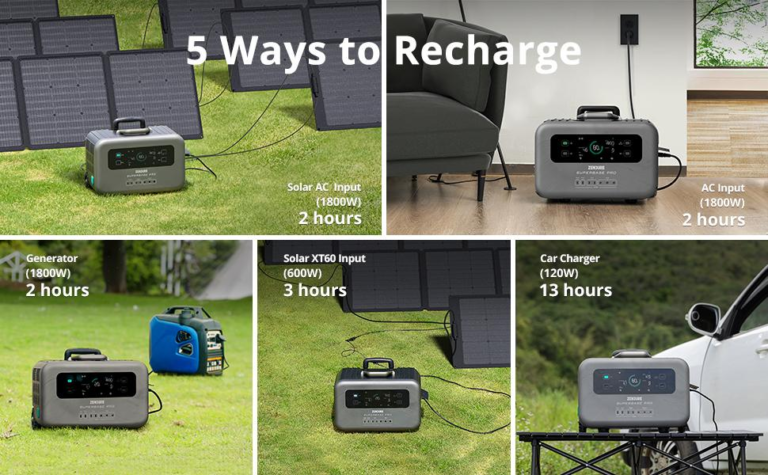
Step 8: Check how you will recharge it
For longer periods away from mains electricity, determine how you will replenish the battery.
Possible methods may include:
Mains charging
Solar charging
Vehicle charging
Expansion batteries or other compatible charging equipment
The right charging method depends on the power station and how you intend to use it.
The calculation is an estimate
The most accurate approach is to use the manufacturer’s runtime information where it is available.
Otherwise, calculate your expected energy use, allow for losses and provide a sensible margin.
This gives you a much better starting point than choosing a power station based solely on its advertised Wh capacity.
For help choosing the right battery capacity before calculating runtime, see our guide to what size power station you need.
Quick Runtime Formula
Then paste:
Estimated runtime = usable battery energy in Wh ÷ appliance power in W
For several appliances:
Estimated energy required = appliance watts × hours of use, added together
For practical planning, always compare the calculated energy requirement with the power station’s usable capacity and compare the combined appliance load with its continuous output rating.
A Real-World Runtime Example
It is useful to see how the calculation works with a realistic combination of devices rather than looking at one appliance in isolation.
Imagine you have a 1,000Wh portable power station and want to use it during a short power outage.
Your planned equipment is:
Television: 100W × 3 hours = 300Wh
Laptop: 60W × 4 hours = 240Wh
Wi-Fi router: 15W × 8 hours = 120Wh
LED lighting: 20W × 2 hours = 40Wh
The estimated total energy requirement is:
300Wh + 240Wh + 120Wh + 40Wh = 700Wh
At first glance, 700Wh appears to fit comfortably inside a 1,000Wh battery.
However, the nominal 1,000Wh capacity should not be treated as 1,000Wh of guaranteed energy delivered to the appliances.
Conversion losses and the power station’s own energy consumption reduce the amount available.
This means the actual result may be considerably closer to the calculated requirement than the battery label suggests.
What happens if the load changes?
Suppose you decide to add a 1,500W kettle.
The kettle might only operate for 10 minutes, so its energy use could be relatively modest:
1,500W × 0.167 hours = approximately 250Wh
That adds another 250Wh to the energy requirement.
However, the more immediate issue is the kettle’s high power demand.
The television, laptop, router and lighting use a combined:
100W + 60W + 15W + 20W = 195W
With the kettle operating, the instantaneous load becomes:
195W + 1,500W = 1,695W
The power station therefore needs sufficient continuous AC output to handle that combined load.
This example demonstrates why battery capacity and power output must be checked separately.
A battery may contain enough stored energy for an appliance but still have an inverter that cannot supply enough power to operate it.
The same calculation can be used for camping
Imagine the same 1,000Wh power station is being used on a camping trip.
Instead of operating the television for three hours, you might use it for only two hours and operate the laptop for three hours.
Reducing your daily energy consumption can extend the time between recharges.
If solar panels are available, some of the energy used during the day may also be replaced before evening.
The most effective way to increase runtime is therefore to understand what you are actually powering, how long you use it and when you can recharge the battery.
How to Improve Portable Power Station Runtime
Once you know how runtime is calculated, there are several practical ways to make your stored energy last longer.
Reduce unnecessary loads
The simplest way to extend runtime is to use less electricity.
Switch off lights when they are not needed, disconnect equipment that is not being used and avoid running high-power appliances unnecessarily.
Even small reductions can add up over several hours.
Use appliances for shorter periods
A high-wattage appliance does not necessarily need to operate continuously.
For example, you may only need a kettle for a few minutes or a microwave for a short cooking cycle.
Limiting the operating time reduces the total energy consumed.
Turn equipment off rather than leaving it idle
Some devices continue to consume electricity while switched on or in standby mode.
During a long outage or off-grid trip, turning off equipment that is not required can preserve battery energy.
Prioritise essential devices
During an extended outage, decide which equipment matters most.
You might prioritise:
Refrigeration
Internet and communications
Essential lighting
Medical or other essential equipment
Less important equipment can be used only when sufficient battery capacity is available.
Use lower-power settings where practical
Some equipment offers different operating modes or brightness settings.
Reducing screen brightness, using a lower fan speed or selecting an energy-saving mode may reduce electricity consumption.
The exact saving depends on the appliance.
Choose an appropriate output
A power station that is vastly larger than necessary may cost more, take up more space and be harder to move.
The goal is not simply to buy the largest possible battery.
Choose a system that has enough battery capacity, sufficient output and appropriate charging options for the equipment you actually intend to use.
Recharge whenever a suitable opportunity is available
If mains electricity becomes available during an outage, recharge the power station.
When camping or caravanning, compatible solar or vehicle charging may provide additional opportunities to replenish the battery.
Using several charging methods can provide greater flexibility.
Use compatible DC or USB outputs where appropriate
Some portable power stations provide USB and DC outputs that allow compatible devices to operate without using the AC inverter.
Depending on the equipment and power station, this may reduce unnecessary conversion.
Only use connections that are electrically compatible with the device and approved by the manufacturer.
Keep the power station within its operating conditions
Extreme temperatures and other environmental conditions can affect battery performance.
Follow the manufacturer’s instructions for operating and charging the power station.
Keeping the unit appropriately stored and maintained can also help preserve battery performance over time.
Plan for cloudy weather when using solar
Solar charging can be extremely useful for off-grid use, but production changes with weather, sunlight and panel positioning.
Do not assume that a solar panel will produce its maximum rated wattage throughout the entire day.
A sensible battery reserve can help when solar production is lower than expected.
The biggest runtime improvement is usually better planning
A larger battery is one way to increase runtime, but reducing unnecessary consumption can be just as useful.
Before buying a larger system, look at your actual usage and determine which appliances are consuming the most energy.
You may discover that changing how you use the existing power station provides more practical benefit than simply adding battery capacity.
A Simple Runtime Checklist
Before relying on a portable power station, run through this checklist:
☐ Check the battery capacity in Wh.
☐ Check the appliance’s actual power requirement in W.
☐ Calculate the expected energy use in Wh.
☐ Allow for conversion losses and the power station’s own consumption.
☐ Check the power station’s continuous AC output.
☐ Check the surge or starting capability for motors and compressors.
☐ Add together appliances that will operate at the same time.
☐ Check that the combined load is within the power station’s output limits.
☐ Consider how long each appliance will actually operate.
☐ Determine how the battery will be recharged.
☐ Consider solar charging for longer periods away from mains electricity.
☐ Allow additional capacity for changing conditions or future needs.
☐ Check the manufacturer’s specifications for the exact model before purchase.
Final runtime check
Before connecting an appliance, you should be able to answer three questions:
Does the power station have enough output to run the appliance?
Does it have enough battery capacity for the required operating time?
Do I have a practical way to recharge it when necessary?
If the answer to all three is yes, you are much more likely to have a system that suits your actual requirements.
Final Thoughts
The answer to how long a portable power station will run depends on the relationship between battery capacity, appliance power and operating time.
The basic calculation is straightforward:
Runtime = available battery energy in Wh ÷ appliance power in W
However, this should be treated as a starting point rather than a guaranteed result.
Real-world runtime is affected by conversion losses, the power station’s own consumption, appliance behaviour, temperature, battery condition and the way the equipment is connected.
The most important thing is to look at both energy and power requirements.
Battery capacity tells you how much energy is stored.
Power output tells you whether the power station can actually operate the equipment.
When choosing a portable power station, calculate your likely energy use, check the continuous and surge output ratings, consider how you will recharge the battery and allow some practical margin.
A power station does not need to be the largest model available to be useful.
The right system is the one that provides enough usable energy, sufficient output and a practical charging solution for the equipment and runtime you actually need.