How to Recharge a Portable Power Station: 5 Charging Methods Explained
A portable power station is only useful for as long as it has enough stored energy to power your devices. Knowing how to recharge a portable power station can help you prepare for a blackout, keep essential equipment running while camping and make better use of solar energy.
Most portable power stations can be recharged from a household power outlet, while many models also support solar charging or charging from a vehicle. Some larger systems offer additional charging options, depending on their design and specifications.
The best charging method depends on how quickly you need to recharge the battery, where you plan to use the power station and whether mains electricity is available. It is also important to check the manufacturer’s instructions because charging limits and compatible accessories vary between models.
This guide explains five ways to recharge a portable power station, what affects charging time and how to choose a suitable method for home backup, camping and off-grid use.
Table of Contents
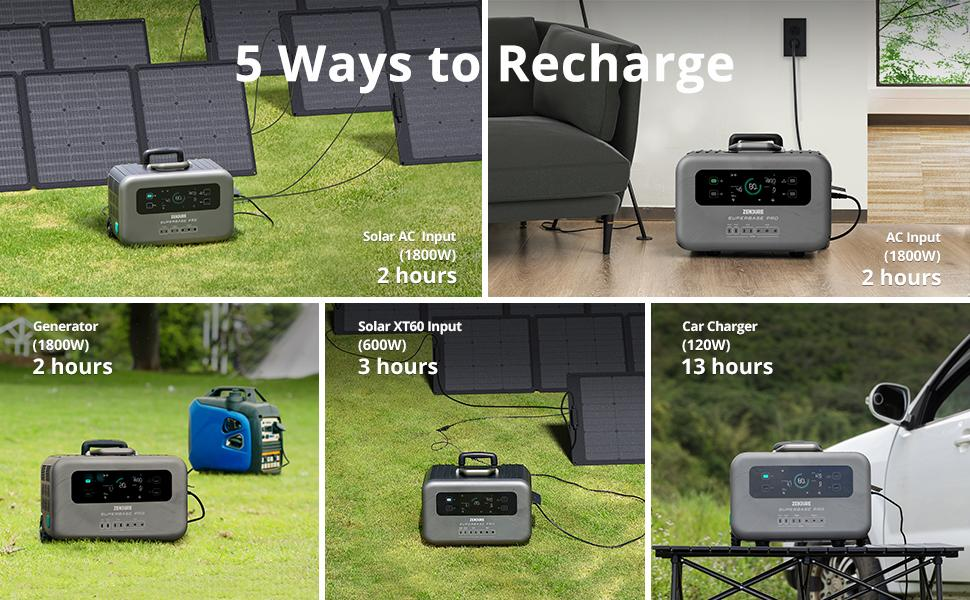
5 Ways to Recharge a Portable Power Station
There is no single charging method that suits every situation. A household outlet may be the most convenient option at home, while solar panels can be useful when you are away from mains electricity.
Before choosing a method, check which charging inputs your power station supports, the maximum permitted input and whether any special cable or accessory is required.
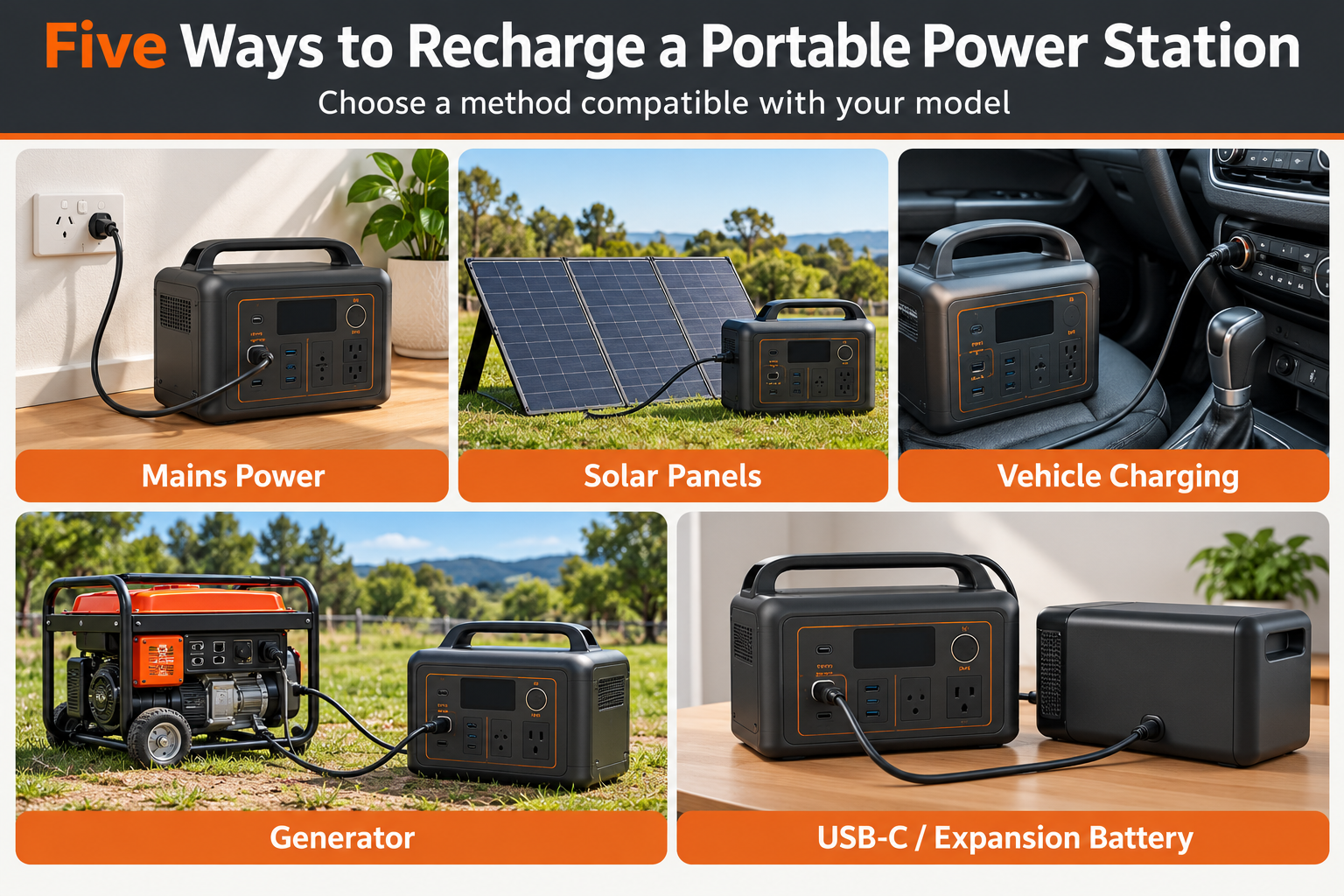
1. Charging From a Household Power Outlet
Charging from a household power outlet is one of the most straightforward ways to recharge a compatible portable power station.
Connect the supplied AC charging cable according to the manufacturer’s instructions and check the display to confirm that charging has started. Some models support faster AC charging than others, so the time required to recharge the battery can vary considerably.
This method is particularly useful when preparing for a power outage, recharging after a camping trip or restoring the battery when mains electricity becomes available.
Use the supplied or manufacturer-approved charging equipment, keep the unit in a suitable ventilated location and follow the manufacturer’s temperature and operating instructions.
2. Charging With Solar Panels
Solar charging allows compatible portable power stations to collect energy from sunlight. It can be particularly useful for camping, caravanning and extended periods away from mains electricity.
However, you cannot assume that every solar panel will work with every power station. Check the permitted solar input voltage, current and wattage before connecting a panel. You should also confirm that the connectors and polarity are compatible.
Actual charging performance depends on several factors, including sunlight intensity, cloud cover, panel angle, shading and the power station’s maximum solar input.
Solar charging may take longer than mains charging, and the rated wattage printed on a panel is not a guarantee of the power it will deliver throughout the day. Allow for changing weather and reduced sunlight when planning an off-grid power supply.
3. Charging From a Vehicle
Many portable power stations can be recharged through a vehicle’s 12V accessory socket using a compatible charging cable. This can be convenient when travelling, camping or moving between destinations.
Vehicle charging is often slower than charging from a household outlet, so it may be better suited to topping up the battery during a trip than recharging a large power station from empty.
Before connecting the unit, check the power station’s vehicle-charging requirements and the vehicle socket’s permitted output. Do not assume that every vehicle socket can safely supply the same amount of power.
Avoid draining your vehicle’s starter battery. Follow the vehicle and power station manufacturers’ instructions, and consider using a compatible alternator charger if your equipment supports one and you need faster charging while travelling.
4. Charging From a Compatible Generator
A generator may provide another way to recharge a portable power station when mains electricity is unavailable. This can be useful during an extended blackout or at a location without a reliable grid connection.
The generator must provide a suitable electrical supply for the power station’s AC charger. Check the manufacturer’s requirements for voltage, frequency, power quality and maximum charging input before connecting the equipment.
Remember that using a generator to recharge a battery involves fuel consumption, noise and maintenance. It may be more practical to run a generator for a planned charging period and then use the power station to supply quieter battery power to selected devices.
Important safety note: Never operate a fuel-powered generator indoors, in a garage or in another enclosed or partially enclosed area. Exhaust contains carbon monoxide, which can be fatal. Operate it outdoors, well away from doors, windows and air intakes, and follow the generator manufacturer’s safety instructions.
5. Using Additional or Alternative Charging Equipment
Some portable power stations support specialised charging equipment or combinations of charging inputs. Depending on the model, these may include compatible alternator chargers, additional solar panels or other manufacturer-approved charging accessories.
Certain units also support charging through USB-C, although this is not available on every model and may provide much less input power than the main charging ports.
Before purchasing extra equipment, confirm that it is compatible with your exact power station. Check the supported input type, voltage, current, wattage and any required cables or adapters.
Using additional charging equipment can improve convenience or reduce charging time in suitable circumstances, but it will not override the power station’s maximum input limits.
How Long Does It Take to Recharge a Portable Power Station?
Charging time depends mainly on the battery’s capacity, how much energy remains, the available charging power and the power station’s maximum permitted input.
A smaller battery may recharge relatively quickly from a suitable wall outlet, while a larger-capacity model can take considerably longer. Solar charging times are less predictable because sunlight and panel output vary throughout the day.
As a rough starting point, you can estimate charging time by dividing the energy that needs to be added by the charging power available.
Estimated charging time in hours = energy required in Wh ÷ charging power in W
For example, if a battery needs approximately 600Wh of additional energy and receives an average charging input of 200W, the simple estimate is:
600Wh ÷ 200W = 3 hours
This is only a theoretical estimate. Real charging times can be longer because of conversion losses, charging overhead, changing input power and the way the battery management system reduces charging power as the battery approaches full capacity.
Always check the manufacturer’s stated charging times for the exact model and charging method.
Charging time is different from runtime. Read our guide on how long a portable power station will run to estimate how long it can power your devices.
Which Charging Method Is Best for You?
The best way to recharge a portable power station depends on where you use it, how quickly you need the battery replenished and what charging equipment is available.
For home backup
If you are preparing for a blackout, charging from a household outlet before an outage is usually the simplest approach. Keeping the battery charged means you have stored energy available when the mains supply fails.
If an outage continues for an extended period, compatible solar panels or another suitable charging source may help replenish the battery. Your options will depend on the power station’s inputs and the conditions available at your home.
For a broader look at backup options, read our guide to solar backup during power outages.
For camping and caravanning
Solar panels can be useful when camping because they may recharge a compatible power station during daylight. Vehicle charging can also help when travelling between destinations.
Consider the battery capacity you need, your daily energy use and how much charging time you realistically have. A larger battery is not necessarily the best option if it is difficult to recharge while you are away.
Before choosing a model for camping or home backup, read our guide to what size power station you need to help match battery capacity to your appliances.
For extended off-grid use
When you are away from mains electricity for several days, plan your energy use and charging arrangements together.
Estimate how much energy your devices will consume, consider how much solar input you can realistically obtain and allow for cloudy weather or other periods of reduced charging.
You may also need to reduce non-essential power consumption so that the stored energy lasts until the next practical charging opportunity.
Before deciding how much battery capacity you need, see our guide to what size power station you need.
How to Recharge a Portable Power Station Safely
Correct charging practices help protect your equipment and reduce avoidable risks. Always follow the manufacturer’s instructions for your exact model, as charging requirements differ between products.
Keep these precautions in mind:
- Use compatible charging equipment. Check that cables, solar panels, adapters and chargers meet the power station’s stated requirements.
- Keep the unit in a suitable location. Follow the manufacturer’s guidance on ventilation, operating temperature and protection from moisture.
- Keep ventilation openings clear. Do not cover the power station or obstruct cooling vents while it is charging.
- Inspect cables and connections. Do not use damaged cables, plugs or connectors.
- Avoid unsuitable temperatures. Battery charging may be restricted at very high or low temperatures. Check the permitted charging temperature range in the manual.
- Monitor unusual behaviour. Stop using the unit if you notice swelling, unusual odours, visible damage or abnormal heat, and contact the manufacturer for advice.
- Never exceed the charging input limits. A charger or solar panel with a higher advertised wattage does not mean the power station can accept that amount of power.
- Follow the instructions for unattended charging. Do not assume that every model can be safely charged in every location or under all conditions.
If you use a fuel-powered generator as a charging source, operate it outdoors and well away from buildings, doors, windows and air intakes. Never run a generator indoors or in an enclosed space because its exhaust can contain lethal carbon monoxide.
A portable power station should also not be connected directly to household wiring as a substitute for a properly installed home backup system. Home circuits require suitable equipment and safe installation by a qualified electrician.
For more battery-charging safety advice, see the Queensland Fire Department’s lithium-ion battery safety guide.
How to Get the Most From Your Charging Equipment
A few practical steps can make charging more convenient and help you plan around the power station’s limitations.
Choose the right charging source for the situation. Use mains charging when it is available and appropriate. Consider solar charging when you have suitable sunlight and compatible equipment, or vehicle charging when it fits your travel arrangements.
Check the maximum input rating. The charging source, cable and power station must all be compatible. The power station’s own input limit determines how much power it can accept.
Avoid relying on ideal conditions. Solar panels rarely deliver their full rated output continuously. Changes in sunlight, cloud, shading and panel angle can affect the amount of energy collected.
Plan around your energy requirements. A charging method that works well for a small battery may be inconvenient for a much larger unit. Consider the amount of energy you need to restore and how much time you have.
Keep track of your actual usage. Observing how quickly your battery level drops during normal use will help you estimate how often you need to recharge and whether your current setup meets your needs.
For help estimating operating time, see our guide to how long a portable power station will run.
Portable Power Station Charging Checklist
Before recharging your power station, work through this checklist:
- Confirm which charging methods your model supports.
- Check the permitted input voltage, current and wattage.
- Use the correct cable, charger or compatible solar panel.
- Check the manufacturer’s instructions for charging temperature and ventilation.
- Estimate how much energy needs to be restored.
- Allow extra time when using solar or vehicle charging.
- Check that cables and connectors are in good condition.
- Plan how you will recharge the battery if mains electricity is unavailable.
- Review the charging instructions before using unfamiliar equipment.
Completing these checks can help you avoid incompatible accessories and make your charging arrangements more reliable.
Frequently Asked Questions
Can you leave a portable power station charging overnight?
Whether overnight charging is appropriate depends on the manufacturer’s instructions and the specific model. Some units have battery management systems that regulate charging, but you should not assume that every device can be left charging unattended. Follow the manufacturer’s recommendations for location, ventilation and charging supervision.
Can you recharge a portable power station while using it?
Some models support simultaneous charging and output, sometimes described as pass-through charging. Support and operating limits vary. Check the manual before using this feature, particularly when connecting appliances with high power demands.
Can a portable power station be charged with any solar panel?
No. Solar panels must meet the power station’s permitted solar input requirements. Check the voltage range, maximum current, wattage and connector compatibility before connecting a panel.
Is solar charging faster than charging from a wall outlet?
Not necessarily. Charging speed depends on the available solar power, the power station’s input limits and the performance of the AC charger. Under suitable conditions, mains charging may be faster and more consistent, while solar charging offers greater flexibility away from the electricity grid.
Does a portable power station need to be fully discharged before recharging?
Do not deliberately run the battery completely flat unless the manufacturer specifically instructs you to do so. Follow the manufacturer’s guidance on routine charging, storage and battery care for your model.
How do you know when a portable power station is fully charged?
Check the display or charging indicators and follow the instructions for your particular model. Some units show a battery percentage or estimated time remaining, while others use indicator lights or an app.
Final Thoughts
Knowing how to recharge a portable power station helps you get more practical value from your equipment, whether you use it at home, while camping or during an extended period away from mains electricity.
Household outlets, compatible solar panels, vehicle charging and suitable generators can all have a role, but the best method depends on your power station’s specifications and your circumstances.
Before choosing a charging setup, check compatibility, understand the available input power and allow realistic time for the battery to recharge. If you are preparing for a blackout or planning an off-grid trip, think about how you will replenish the battery as well as how much energy you need to store.
The most useful charging arrangement is one that safely fits your equipment, available energy sources and expected needs.
Choosing how to recharge a portable power station comes down to the charging methods your model supports, the equipment available and how much time you have.