What Can a Portable Power Station Run? A Practical Appliance Guide
What can a portable power station run? The answer depends on two main things: how much electrical power the appliance needs and how much energy the power station can store.
Portable power stations can operate a wide range of equipment, from phones and laptops to televisions, refrigerators and selected higher-power appliances. However, not every power station can run every appliance, and battery capacity alone does not determine whether a device will work.
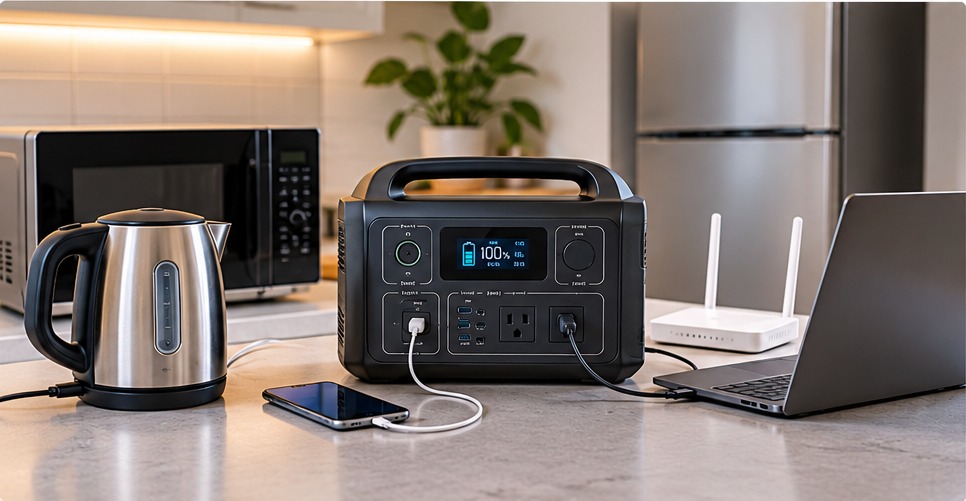
You need to consider the appliance’s wattage, starting or surge requirements, expected runtime and the power station’s continuous AC output and battery capacity.
This guide explains what you can realistically run from different power station sizes and shows you how to check an appliance before connecting it.
Table of Contents
What Can a Portable Power Station Run?
A portable power station can run many of the electrical devices used at home, while camping, caravanning, travelling or during a power outage. The important question is not simply whether an appliance can be plugged into the power station, but whether the station has enough continuous output, surge capability and battery capacity for that appliance.
Small electronic devices such as phones, tablets, cameras, laptops and LED lights generally require relatively little power. Larger appliances such as refrigerators, televisions, microwaves and cooking equipment can require considerably more.
The exact power requirement varies between products, so the appliance manufacturer’s specifications should always be checked before choosing a power station.
Common appliances a power station may run
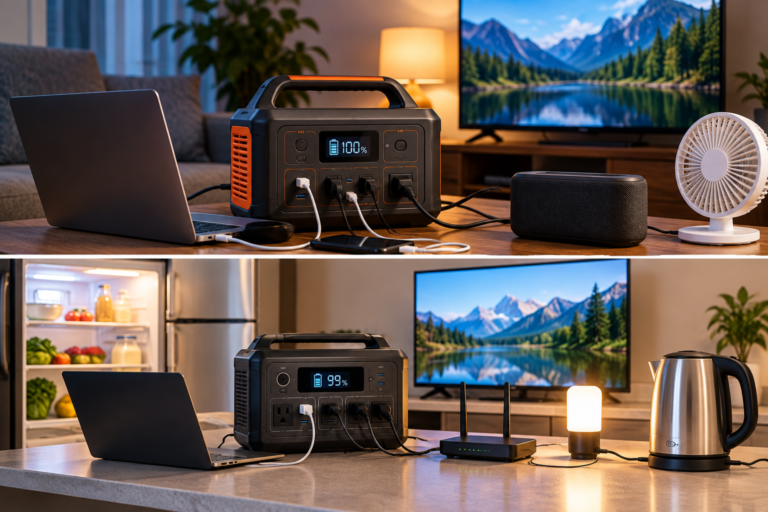
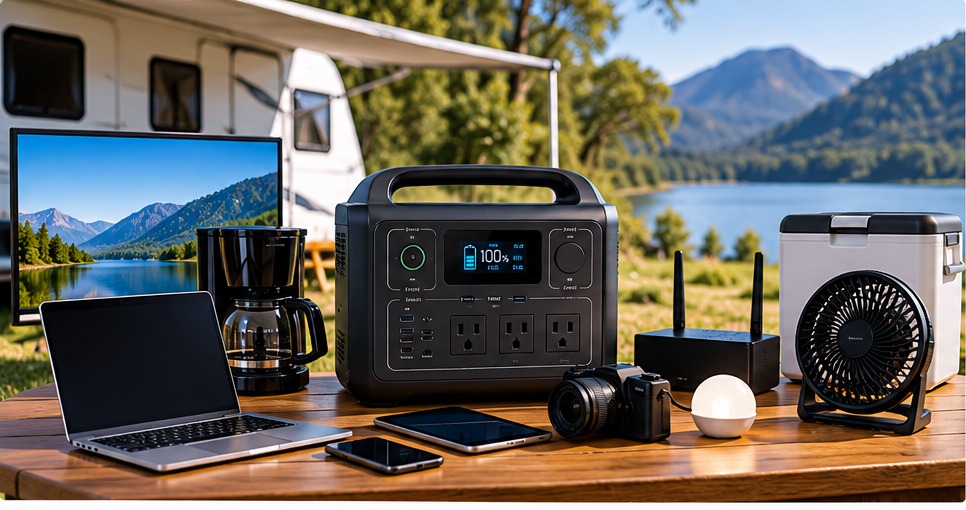
Depending on the size and output of the power station, common loads can include:
Mobile phones and tablets
Laptops and computers
Wi-Fi routers and networking equipment
LED lights
Televisions
Fans
Portable refrigerators and freezers
CPAP machines
Camera and electronic equipment
Small kitchen appliances
Microwaves
Kettles and coffee makers
Some power tools
Whether a particular appliance will work depends on its actual electrical requirements and the specifications of the power station.
Some appliances are easier to run than others
Low-power electronics are generally easier to operate from a portable power station because they use relatively little electricity and usually do not require a large startup surge.
Appliances that generate heat can have much higher continuous power requirements. Kettles, microwaves, toasters and some cooking appliances can therefore require a power station with substantially higher AC output.
Appliances containing motors or compressors require another consideration. Refrigerators, freezers, pumps and some tools can draw additional power when starting, so the power station needs enough surge capability as well as sufficient continuous output.
Battery capacity affects runtime
Even when a power station can operate an appliance, the battery may not run it for as long as expected.
Battery capacity is measured in watt-hours (Wh). The higher the Wh rating, the more stored energy the battery has, although the amount actually available to connected equipment depends on the particular power station and its conversion efficiency.
For example, a power station may be able to operate a television without difficulty, but a larger battery will generally be required if you want to operate that television for many hours.
The same principle applies to every other appliance. A device that uses relatively little power may run for a long time, while a high-power appliance can use a substantial amount of stored energy in a much shorter period.
Check what you want to run at the same time
Another important consideration is the combined load.
A power station may be able to operate a laptop by itself and a television by itself, but you also need to check whether its continuous output can handle both devices operating together.
For example, if several appliances are expected to operate simultaneously, add their running wattages and compare the total with the power station’s continuous AC output.
You should also consider whether any of those appliances have a higher startup requirement.
Your power station needs to match the job
A small power station can be very useful for charging electronics and running lighting.
A medium-capacity unit can provide more flexibility for televisions, computers, networking equipment and selected camping appliances.
A larger system may be more suitable when you need refrigeration, longer runtime, multiple appliances or higher-powered equipment.
There is no single capacity that will run every appliance. The correct choice depends on the equipment you need to operate, how long you need it to run and how the power station will be recharged.
Always check the appliance specifications
Before connecting an appliance, check its manufacturer’s information for:
Rated or running power
Maximum power, where specified
Starting or surge requirements, where applicable
Energy consumption information
Then compare those figures with the power station’s:
Continuous AC output
Surge or peak output
Battery capacity
If the appliance’s requirements exceed the power station’s limits, do not connect it simply because the power station has a large battery.
The safest approach is to match the appliance’s electrical requirements with the complete specifications of the power station before use.
Understanding Watts and Watt-Hours
To understand what a portable power station can run, you need to understand the difference between watts (W) and watt-hours (Wh).
These two measurements describe different things.
The Australian Government battery guidance also explains the difference between battery capacity and power output.
Watts (W) measure power. They indicate how much electrical power an appliance needs while it is operating.
Watt-hours (Wh) measure energy. They indicate how much energy a battery can store or how much energy an appliance uses over a period of time.
This distinction is important when choosing a power station.
Watts determine what you can run
The power output of a portable power station is normally given in watts.
For example, if a power station has a 1,800W continuous AC output, it is designed to supply up to that amount of AC power under the manufacturer’s specified conditions.
If several appliances are connected at the same time, their combined power requirements need to remain within the station’s output capability.
For example:
Television: 100W
Laptop: 60W
Wi-Fi router: 15W
LED lighting: 20W
Combined load:
100W + 60W + 15W + 20W = 195W
A power station capable of supplying more than this combined load could potentially operate these devices simultaneously, subject to its specifications and the actual consumption of the equipment.
Watt-hours determine how long the battery can provide energy
Battery capacity is commonly expressed in watt-hours.
A 1,000Wh power station stores more energy than a 500Wh power station, although the amount of energy actually available to connected appliances depends on the particular system and conversion losses.
A simple estimate is:
Watts × hours = watt-hours
For example, a 100W appliance operating for 5 hours would use:
100W × 5 hours = 500Wh
This is a simplified calculation. Actual battery runtime can be shorter because of inverter losses, the power station’s own energy consumption and changes in the appliance’s power demand.
You need both numbers
This is where many power station buyers become confused.
A power station can have a large battery but insufficient output for a particular appliance.
For example, a power station might have a high Wh capacity but a relatively low AC output. It could run low-power electronics for a long time but still be unable to operate a high-wattage appliance.
The opposite can also happen.
A power station may have sufficient output to operate an appliance but not enough battery capacity to operate it for the required period.
That is why you need to consider both power output and battery capacity.
Running power and starting power can be different
Some appliances do not use the same amount of power every moment.
Refrigerators, freezers, pumps, fans and other motor-driven equipment can require additional power when starting.
This means you should check the appliance’s starting or surge requirement where that information is available.
The power station needs enough continuous output for normal operation and sufficient surge capability for temporary increases in demand.
A simple way to remember it
Think of watts as how much power the appliance needs right now.
Think of watt-hours as how much stored energy you need over time.
For example, a 1,000W appliance running for one hour would theoretically use:
1,000W × 1 hour = 1,000Wh
A 100W appliance running for ten hours would also theoretically use:
100W × 10 hours = 1,000Wh
The appliances have very different power requirements, but the theoretical energy requirement is the same.
This illustrates why battery capacity alone does not tell you what a power station can run.
Allow for real-world conditions
The calculations above are useful for estimating requirements, but they should not be treated as exact runtime figures.
Actual results can be affected by:
Inverter efficiency
Appliance efficiency
Changes in appliance power consumption
Temperature and operating conditions
The power station’s own energy consumption
Battery management and manufacturer limits
For appliances that cycle on and off, such as refrigerators, the average energy consumption may be considerably different from the maximum running wattage.
Whenever possible, use the manufacturer’s specifications for the actual appliance you intend to operate.
The key point
When deciding what a portable power station can run, ask two separate questions:
Does the power station have enough output in watts to operate the appliance?
Does it have enough battery capacity in watt-hours to operate it for the required period?
Once both questions have been answered, you can make a much more accurate assessment of whether the power station is suitable for your intended equipment.
For help choosing the right capacity, see our power station sizing guide.
What Can a Portable Power Station Run at Different Capacities?
Under 500Wh
Power stations under 500Wh are generally best suited to lighter electrical loads where portability is important.
They can be useful for charging smartphones, tablets, cameras and other small electronics, as well as operating LED lights, small fans and similar low-power equipment.
For example, a small power station may be suitable for keeping communication devices charged during a day trip or short camping trip.
The key limitation is not only battery capacity but also AC output. A small unit may have enough stored energy for several electronic devices but still be unable to operate a higher-wattage appliance.
Before choosing a power station in this range, check both its battery capacity and continuous output.
500–1,000Wh
A 500–1,000Wh power station provides more stored energy while remaining relatively practical for camping, travel and caravanning.
Depending on its output, it may be suitable for laptops, televisions, lighting, networking equipment, fans and other moderate-power devices.
This capacity range can work well when your electrical needs are relatively modest and you have an opportunity to recharge the battery regularly.
A 1,000Wh-class system can provide considerably more stored energy than a smaller unit, but the exact runtime will still depend on the appliances connected to it and how long they operate.
For multiple appliances, check their combined running wattage and compare it with the power station’s continuous AC output.
1,000–2,000Wh
Power stations in the 1,000–2,000Wh range can provide a useful balance between stored energy and portability.
They can be suitable for longer camping trips, caravanning, home-office backup, refrigeration and selected household appliances when the power station has sufficient output.
This capacity range becomes particularly useful when you need several devices to operate during the same day rather than simply charging small electronics.
Remember that battery capacity and output are separate specifications. A 2,000Wh battery may provide substantial stored energy, but it still needs sufficient continuous and surge output for the appliances you want to operate.
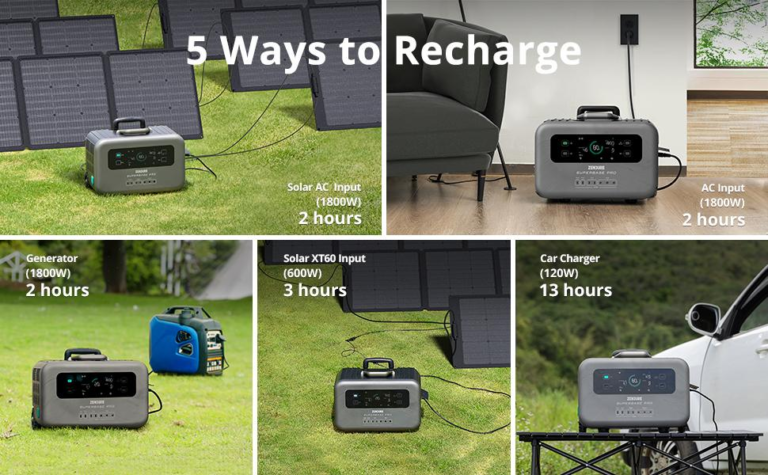
For extended off-grid use, also consider how the battery will be recharged. Compatible solar panels, vehicle charging or mains charging can help replenish the stored energy between uses.
2,000Wh and Above
Power stations with 2,000Wh or more provide substantially more stored energy and can be useful when you need longer runtime or expect to operate several appliances throughout the day.
They may be suitable for extended caravanning, larger backup requirements, refrigeration, multiple electronic devices and selected higher-demand appliances, provided the system has sufficient output.
Larger-capacity systems can also be useful when you want more energy available between charging periods. This can be particularly important when solar production varies or when mains electricity is unavailable for an extended period.
However, larger power stations are generally heavier and take up more storage space than smaller units. Consider how and where you will use the system before selecting a larger capacity.
Also check the manufacturer’s specifications for continuous AC output, surge capability, charging input and expansion options. A high Wh rating does not by itself guarantee that a power station can operate every appliance.
The most suitable capacity is therefore determined by the combination of energy requirements, power requirements, runtime, charging options and portability.
Can a Portable Power Station Run a Refrigerator?
Yes, a portable power station can run a refrigerator, provided the power station has sufficient continuous AC output, surge capability and usable battery capacity for the refrigerator.
A refrigerator is different from many electronic devices because its compressor cycles on and off and may require more power when the compressor starts.
Check the refrigerator’s power requirements
Before choosing a power station, check the refrigerator manufacturer’s specifications or owner’s manual.
Look for:
Rated or running power
Starting or maximum power, where provided
Energy consumption over time
The running wattage helps determine the continuous output required from the power station.
The starting requirement is important because the compressor may briefly demand more power when it switches on.
Battery capacity affects runtime
Once you know the refrigerator’s expected energy consumption, you can estimate how much battery capacity you need.
A basic calculation is:
Power in watts × operating time in hours = watt-hours
However, a refrigerator does not normally operate continuously at its maximum rated wattage. The compressor switches on and off, so actual energy consumption over a day can be considerably different from simply multiplying maximum running wattage by 24 hours.
Whenever available, use the manufacturer’s energy-consumption information rather than relying only on the refrigerator’s maximum wattage.
You should also allow for losses when the power station converts battery energy into AC power.
Continuous output and surge output both matter
A power station must have enough continuous AC output to operate the refrigerator during normal operation.
It must also have sufficient surge capability to handle the compressor starting.
A power station with a large battery but insufficient output may still be unable to start the refrigerator.
This is why refrigerator compatibility should always be checked against the complete specifications of both the refrigerator and the power station.
How much battery capacity do you need?
There is no single battery size that will work for every refrigerator.
Actual energy use depends on the refrigerator model, size, efficiency, ambient temperature, door-opening frequency and operating conditions.
For a longer blackout or off-grid trip, a larger battery provides more stored energy between charging periods.
Solar charging can also help replenish the battery during daylight hours when the power station and solar panels are compatible.
The practical approach
When planning to run a refrigerator from a portable power station, check these three things:
1. Continuous AC output — enough to run the refrigerator.
2. Surge capability — enough to handle compressor startup.
3. Battery capacity — enough usable energy for the required runtime.
Do not select a power station based on Wh capacity alone.
A suitable system needs to satisfy all three requirements at the same time.
Can It Run a Television?
Yes, a portable power station can run a television when the station’s AC output is sufficient for the television and its battery has enough usable capacity for the amount of viewing time required.
Televisions are generally easier to power than high-wattage heating appliances, but their actual electricity use varies considerably by screen size, display technology, brightness settings and model.
Check the television’s manufacturer’s specifications or power label for its rated consumption.
For example, if a television uses 100W and operates for 4 hours:
100W × 4 hours = 400Wh
This is a simplified energy calculation and does not account for conversion losses.
Check the television’s power requirement
Before connecting a television, check:
Rated power consumption
AC voltage requirements
Power station continuous AC output
Available battery capacity
A television may use relatively little power compared with appliances such as kettles or microwaves, making it practical for many medium and larger portable power stations.
Consider the rest of your equipment
If you are watching television while also running lights, a router, laptop or other equipment, add the expected loads together.
For example:
Television: 100W
LED lighting: 20W
Wi-Fi router: 15W
Total simultaneous load:
135W
The power station needs sufficient continuous output for the combined load.
How long will a television run?
Runtime depends mainly on the television’s actual consumption and the usable energy available from the battery.
A larger battery provides more stored energy, while a smaller television or lower brightness setting may reduce electricity consumption.
For camping and caravanning, also consider how you will recharge the power station after several hours of television use.
Can It Run a Microwave?
A portable power station may be able to run a microwave, but this requires considerably more attention to the power station’s AC output than running small electronic devices.
Microwave ovens can have high electrical power requirements, so you should check the microwave’s actual input power and compare it with the power station’s continuous output.
Check the microwave’s input power
The wattage printed on a microwave may refer to cooking output rather than the amount of electrical power it draws from the wall.
For accurate sizing, use the manufacturer’s electrical input specification.
The power station needs sufficient continuous AC output for the microwave’s actual electrical demand.
Runtime is usually short
Although a microwave can require substantial power while operating, it is often used for relatively short periods.
For example, a 1,200W microwave used for 10 minutes would theoretically consume:
1,200W × 0.167 hours = approximately 200Wh
This is an energy estimate rather than a guaranteed battery-runtime figure because conversion losses and actual appliance consumption also need to be considered.
Check the combined load
Do not assume that a power station capable of running the microwave can also operate several other appliances at the same time.
A microwave, television, kettle or other high-power appliance can quickly increase the total load.
Check the combined wattage of everything you expect to use simultaneously and compare it with the power station’s continuous AC output.
Is a microwave practical off-grid?
A microwave can be practical with a sufficiently powerful power station, particularly when it is used for short periods.
However, its relatively high power demand can place substantial load on a battery system, especially if you use it repeatedly throughout the day.
For regular off-grid cooking, consider the microwave’s electrical consumption, the number of times it will be used and how the power station will be recharged.
Can It Run a Kettle or Coffee Maker?
A portable power station can run some kettles and coffee makers, but these appliances can require considerably more electrical power than laptops, televisions or lighting.
Heating appliances are often among the more demanding loads you can connect to a portable power station.
Check the appliance wattage
Before using a kettle or coffee maker, check the manufacturer’s rated electrical input.
A high-wattage kettle may require more continuous AC output than a compact power station can provide.
The same applies to coffee makers, espresso machines and other equipment that uses an electric heating element.
Calculate the energy used
The good news is that kettles and coffee makers are often operated for relatively short periods.
For example, a 1,500W appliance running for 5 minutes would theoretically use:
1,500W × 0.083 hours = approximately 125Wh
Repeated use throughout the day would increase the total energy consumption.
Check the power station’s continuous output
The first question is whether the power station can supply enough continuous AC power.
A power station with a large battery but insufficient AC output may still be unable to operate the kettle or coffee maker.
Do not rely on battery capacity alone.
Consider repeated use
If you use a high-wattage kettle several times a day, the total energy consumption can become significant.
When camping or caravanning, using only the amount of water required can reduce unnecessary energy use.
For longer off-grid trips, also consider whether your solar panels or other charging method can replace the energy consumed by cooking appliances.
Coffee makers can vary considerably
Coffee makers differ widely in power requirements.
A simple appliance may use relatively modest power, while a machine with heating elements, pumps and other features may require substantially more.
Always check the specifications for the exact appliance you intend to use.
Can It Run a Laptop and Wi-Fi Router?
Yes, most appropriately sized portable power stations can run a laptop and Wi-Fi router, and these are generally much easier electrical loads to manage than high-power heating appliances.
Their relatively modest power requirements can make them useful during camping, caravanning, remote work and short power outages.
Laptop power requirements
Laptop power consumption varies according to the computer, charger and workload.
A basic laptop performing everyday tasks may use considerably less power than a high-performance computer running demanding software.
Check the laptop charger’s specifications where possible and use your actual equipment when estimating energy requirements.
For example, a laptop averaging 60W for 6 hours would theoretically use:
60W × 6 hours = 360Wh
Actual consumption can be lower or higher depending on the computer and what it is doing.
Wi-Fi router power requirements
A Wi-Fi router generally uses relatively little power compared with most household appliances.
If a router consumes 15W continuously for 8 hours:
15W × 8 hours = 120Wh
For a full 24-hour period:
15W × 24 hours = 360Wh
Again, these are simplified calculations. Actual router consumption depends on the specific equipment.
Running both together
If the laptop uses 60W and the router uses 15W, the combined running load would be:
60W + 15W = 75W
A power station with sufficient continuous output should be able to handle this combined load, provided the battery has enough usable capacity for the required runtime.
Reduce unnecessary battery use
During an outage or while camping, you can often extend battery runtime by changing how you use the equipment.
For example, you might keep the router operating while using the laptop only when necessary.
Reducing screen brightness, closing unnecessary applications and using the laptop’s power-saving settings may also reduce energy consumption.
Consider how you will recharge
For longer periods away from mains electricity, charging becomes just as important as battery capacity.
A suitable power station may keep your laptop and router operating for many hours, but eventually the stored energy needs to be replaced.
For extended camping, caravanning or remote work, consider whether mains, solar or compatible vehicle charging can replenish the battery.
Can It Run Lights and Fans?
Yes. Lights and fans are often among the easier household loads to operate from a portable power station, particularly when using LED lighting and energy-efficient fans.
The main things to check are the appliance’s running wattage and the amount of time you expect to use it.
Lighting
LED lights generally require much less power than older types of lighting.
For example, if a 20W light operates for 5 hours:
20W × 5 hours = 100Wh
This is a simple estimate of the energy used by the light. Actual battery consumption will also depend on the efficiency of the power station and its AC conversion losses.
Several lights can be operated together, but their combined wattage should be included when calculating the total load.
Fans
Fans can also be suitable for portable power stations, although power requirements vary by fan size, motor type and operating speed.
A fan may draw relatively little power while operating, but a motor can have a higher starting requirement.
Check the fan’s rated power and compare it with the power station’s continuous AC output.
Extend your runtime
If you are using a power station during a blackout or while camping, reducing unnecessary lighting and using a fan only when required can preserve battery capacity.
For longer periods away from mains electricity, also consider how the battery will be recharged.
The important point is that even relatively small appliances consume energy when operated for many hours, so include their expected operating time when estimating your total Wh requirement.
Can It Run a CPAP Machine?
A portable power station can be used to operate many CPAP machines, but the exact requirements depend on the CPAP model and the accessories being used.
Because CPAP equipment can be important overnight, do not rely on a general wattage estimate. Check the manufacturer’s specifications for your exact machine.
Check the CPAP manufacturer’s specifications
Look for the machine’s electrical requirements and check whether the manufacturer provides information about operation from AC power, DC power or a battery system.
Also consider whether you use:
Heated humidification
Heated tubing
Additional accessories
These can change the amount of energy required compared with operating the CPAP machine alone.
Battery capacity matters
A CPAP machine may operate for several hours from a suitable power station, but the required battery capacity depends on the machine’s actual consumption and the duration of use.
For overnight operation, calculate the expected energy requirement for the full period rather than choosing a power station based only on the machine’s running wattage.
Check the power output and connection
The power station must provide a compatible output and sufficient continuous power for the CPAP equipment.
Where possible, use the manufacturer’s recommended power supply or compatible connection method.
Do not assume that every USB or DC output is suitable for every CPAP machine.
Allow for more than one night
If the power station needs to support CPAP equipment during an extended outage or camping trip, consider how many nights are required between charges.
A larger battery may provide more operating time, while solar or another compatible charging method may help replenish the battery during the day.
For equipment that is essential to your routine, check the CPAP manufacturer’s guidance before relying on a portable power station as the sole power source.
Can It Run Cooking Appliances?
Some cooking appliances can be operated from a portable power station, but cooking equipment often has relatively high electrical requirements.
Kettles, toasters, microwaves, electric frypans, hotplates, air fryers and similar appliances can place a substantial load on a battery system.
Check the actual wattage
Before connecting a cooking appliance, check the manufacturer’s electrical input rating.
Do not assume that two appliances of the same type use the same amount of power.
The power station needs enough continuous AC output for the appliance’s electrical demand.
Short use can still consume significant energy
A high-power cooking appliance may only operate for a few minutes at a time, but it can still use a noticeable amount of battery energy.
For example, a 1,500W appliance used for 10 minutes would theoretically consume:
1,500W × 0.167 hours = approximately 250Wh
This is a simplified calculation and does not include conversion losses.
Repeated use throughout the day would increase the total energy requirement.
Avoid overloading the power station
Do not run several high-power cooking appliances simultaneously unless the power station is specifically rated to handle their combined load.
For example, operating a kettle while an air fryer or microwave is running can create a much larger instantaneous load than using either appliance separately.
Add the running wattages of appliances that may operate together and compare the result with the power station’s continuous AC output.
Consider alternative cooking methods
For extended camping or off-grid use, you may be able to reduce electricity consumption by using gas or other non-electric cooking methods where appropriate and permitted.
This can preserve stored battery energy for refrigeration, communications, lighting and other electrical equipment.
Calculate your daily cooking needs
If you regularly use electric cooking appliances, estimate how many minutes each appliance operates per day.
You can then calculate their approximate energy requirements and include those figures in your overall battery-sizing calculation.
The goal is not simply to find a power station that can switch the appliance on. You also need enough stored energy for the amount of cooking you expect to do.
Can It Run Power Tools?
Portable power stations can operate some power tools, but compatibility depends heavily on the tool’s electrical requirements and the power station’s output capabilities.
Power tools can have relatively high running loads and some motor-driven tools may also require additional power when starting.
Check the tool’s requirements
Before connecting a power tool, check the manufacturer’s specifications for:
Rated power
Maximum power, where provided
Starting or surge requirements
The power station needs enough continuous output for normal operation and enough surge capability for any temporary increase in demand.
Consider the type of tool
Different power tools can have very different electrical requirements.
A small tool may be relatively easy to operate from a suitable portable power station, while a larger saw, grinder, compressor or other high-demand tool may require substantially more output.
Do not judge compatibility based on the tool type alone. Use the specifications for the exact model.
Runtime is also important
A power tool may draw considerable power while operating, but it may only be used for short periods.
For example, a 1,000W tool used for 15 minutes would theoretically use:
1,000W × 0.25 hours = 250Wh
Actual battery consumption will vary because of conversion losses and changes in the tool’s power demand.
Check the total load
If other equipment is running at the same time, add its power requirement to the tool’s expected load.
The combined demand must remain within the power station’s continuous output capability.
Use caution with demanding equipment
If the power station repeatedly reaches its output limit, it may shut down or activate its protection systems.
Always follow the power station manufacturer’s instructions and the tool manufacturer’s operating requirements.
For larger tools and workshop equipment, compare the complete electrical specifications before attempting to use them with a portable battery system.
How Long Can Appliances Run?
The runtime of an appliance depends mainly on its power consumption, the power station’s usable battery energy and how efficiently the stored energy is converted into the required output.
A simple starting calculation is:
Battery capacity in Wh ÷ appliance power in W = theoretical operating time in hours
For example, a 1,000Wh battery connected to a 100W appliance gives a theoretical result of:
1,000Wh ÷ 100W = 10 hours
This is not a guaranteed real-world runtime.
Allow for conversion losses
When battery energy is converted into AC power, some energy is lost.
The power station also consumes energy while operating, so the amount available to the appliance will normally be less than the nominal battery capacity.
For this reason, actual runtime should be expected to be shorter than the simple mathematical result.
Appliances do not always use constant power
Some appliances have relatively steady consumption, while others cycle on and off or change their power demand.
A refrigerator is a good example.
Its compressor does not necessarily run continuously at its maximum rated power, so estimating its runtime from maximum wattage alone can produce a misleading result.
Example with several appliances
Suppose a power station is being used for:
Television: 100W × 4 hours = 400Wh
Laptop: 60W × 5 hours = 300Wh
LED lighting: 20W × 5 hours = 100Wh
Wi-Fi router: 15W × 8 hours = 120Wh
The simplified total is:
400Wh + 300Wh + 100Wh + 120Wh = 920Wh
A power station with a nominal 1,000Wh battery would not necessarily deliver the full 1,000Wh to these AC loads because of conversion losses and the station’s own consumption.
You therefore need to allow some margin rather than choosing a battery that exactly matches the theoretical calculation.
Runtime changes when appliances are combined
The more equipment you operate, the faster the stored energy is consumed.
Running a television and laptop together for several hours will use more energy than operating either device individually.
The instantaneous combined wattage also needs to remain within the power station’s continuous output rating.
Use manufacturer information where available
For appliances with published energy-consumption figures, use those figures rather than relying entirely on generic wattage estimates.
This is particularly useful for refrigerators, freezers and other appliances that cycle or vary their consumption.
A practical runtime approach
To estimate real-world runtime:
1. List every appliance you expect to use.
2. Record its approximate power consumption.
3. Estimate how many hours or minutes it will operate.
4. Calculate the approximate Wh requirement.
5. Add a reasonable allowance for conversion losses and changes in use.
6. Check that the power station’s continuous and surge output can handle the appliances.
This gives you a much more useful estimate than simply dividing the advertised battery capacity by the wattage of one appliance.
What Appliances Use the Most Power?
The appliances that use the most electricity are generally those that produce heat, cool air or water, or use powerful motors.
Common high-demand appliances can include:
Electric kettles
Microwaves
Toasters
Air fryers
Electric hotplates
Heaters
Hair dryers
Vacuum cleaners
Some power tools
The exact power requirement varies significantly between models, so always check the manufacturer’s specifications for the appliance you intend to use.
Heating appliances can use substantial power
Kettles, toasters, air fryers and similar appliances can draw a high amount of power while operating.
They may only be used for a short period, but their instantaneous wattage can be high.
This means you need to check the power station’s continuous AC output before connecting them.
Refrigeration is different
Refrigerators and freezers may have a lower running wattage than some heating appliances, but their compressors can require additional power when starting.
They also operate over much longer periods.
As a result, refrigeration needs to be assessed using both power output and energy consumption.
Electronics usually use less power
Laptops, phones, routers, LED lights and similar electronic equipment generally have lower power requirements than heating appliances.
This does not mean that their energy use is always insignificant. A device that operates continuously for many hours can still consume a considerable amount of stored energy.
For example, a 15W device operating continuously for 24 hours would theoretically use:
15W × 24 hours = 360Wh
Check your actual appliances
Generic wattage tables are useful for planning, but your actual appliances may use more or less electricity than a typical example.
Whenever possible, check the appliance label, owner’s manual or manufacturer’s specifications.
For power station sizing, use the exact equipment you expect to operate rather than relying entirely on average figures.
Can You Run Multiple Appliances at Once?
Yes, a portable power station can run multiple appliances at once when the combined electrical load remains within its output limits and the battery has enough usable energy for the required operating period.
This is where both watts and watt-hours become important.
Add the running wattage
Start by adding the running wattage of the appliances you expect to use simultaneously.
For example:
Television: 100W
Laptop: 60W
Wi-Fi router: 15W
LED lighting: 20W
Combined running load:
100W + 60W + 15W + 20W = 195W
The power station therefore needs sufficient continuous AC output to handle that combined load.
Remember starting or surge requirements
The combined running wattage is not always the complete picture.
If one of the appliances has a motor or compressor, it may require additional power when starting.
A refrigerator is an example of a device that can have a higher startup demand than its normal running power.
The power station therefore needs adequate surge capability as well as sufficient continuous output.
High-power appliances can quickly increase the load
Running a television, laptop and router together may create a relatively modest load.
Adding a kettle, microwave or other high-power appliance can increase the instantaneous demand substantially.
For example, if a 1,500W kettle is switched on while the other equipment is running:
1,500W + 195W = 1,695W
The power station would need sufficient continuous output to support that combined demand.
Battery capacity also matters
Even when the power station can handle the combined wattage, operating several appliances simultaneously consumes stored energy faster.
The battery therefore needs sufficient usable capacity for the total operating period.
For longer use, calculate the approximate watt-hours for all appliances and allow for conversion losses.
Avoid relying on the maximum rating alone
Always compare your expected load with the manufacturer’s stated continuous output and surge limits.
Do not assume that the highest number printed on the power station means it can supply that level indefinitely.
The manufacturer’s operating limits and instructions take priority.
Plan which appliances need to run together
One practical way to reduce the required power station size is to avoid operating several high-demand appliances at the same time.
For example, using a microwave after an air fryer has finished may be more practical than running both simultaneously.
This can reduce the peak load and make better use of the available battery capacity.
How to Check if Your Power Station Can Run an Appliance
Before connecting an appliance, compare the appliance’s electrical requirements with the power station’s specifications.
A simple check can prevent two common mistakes: choosing a power station with enough battery capacity but insufficient output, or choosing one with enough output but insufficient energy for the required runtime.
Step 1: Find the appliance’s power requirement
Check the appliance label, owner’s manual or manufacturer’s specifications.
Look for:
Rated or running power
Maximum power, where provided
Starting or surge requirements
Energy consumption information
Use the figures for the exact appliance rather than assuming that every appliance of the same type has identical requirements.
Step 2: Check the power station’s continuous output
Find the power station’s continuous AC output rating.
Compare it with the appliance’s normal operating requirement.
If the appliance requires more continuous power than the power station can supply, the system is not suitable for that load.
Step 3: Check surge capability
If the appliance has a motor, compressor or another type of startup surge, check the power station’s surge or peak specification.
The power station needs to be capable of handling the temporary increase in demand.
Step 4: Calculate the expected energy use
Estimate how long the appliance will operate.
Use:
Watts × hours = watt-hours
For example:
100W × 4 hours = 400Wh
This gives you a starting estimate of the energy required.
Step 5: Allow for real-world losses
Do not expect a power station to deliver its entire advertised battery capacity to an AC appliance.
Energy is lost during conversion, and the power station itself also uses some energy.
Actual runtime can therefore be shorter than the simple calculation suggests.
Step 6: Check the combined load
If multiple appliances will be operating at the same time, add their running wattages together.
Then compare the combined load with the power station’s continuous AC output.
Also check whether any of the appliances have startup or surge requirements.
Step 7: Check how the battery will be recharged
For camping, caravanning and extended off-grid use, determine how you will replace the energy consumed.
Depending on the power station, this could include:
Mains charging
Solar charging
Compatible vehicle charging
Another supported charging method
The final compatibility test
A power station is suitable for an appliance when:
The continuous output is sufficient.
The surge capability is sufficient where required.
The battery capacity is sufficient for the required runtime.
The connection and voltage requirements are compatible.
The manufacturer’s instructions permit the intended use.
Check all of these before relying on a portable power station to operate an important appliance.
A Simple Appliance Compatibility Checklist
☐ Check the appliance’s rated wattage
☐ Check its maximum or starting power, where provided
☐ Check the power station’s continuous AC output
☐ Check the power station’s surge or peak output
☐ Estimate the appliance’s operating time
☐ Calculate the approximate watt-hours required
☐ Allow for conversion losses and real-world variation
☐ Add together appliances that will operate simultaneously
☐ Check that the combined load is within the power station’s output rating
☐ Check that the battery has enough usable capacity
☐ Consider how the battery will be recharged
☐ Confirm that the appliance and power station connections are compatible
☐ Follow the manufacturer’s instructions
Before you buy
Record the following information for each appliance you plan to use:
| Appliance | Running Power | Starting Power | Expected Use |
|---|---|---|---|
| Television | Check specification | Usually not a major startup load | Hours per day |
| Laptop | Check specification | Usually low | Hours per day |
| Refrigerator | Check specification | Check compressor startup requirements | Continuous/cycling |
| Microwave | Check specification | Check manufacturer information | Minutes per use |
| Kettle | Check specification | Check if applicable | Minutes per use |
| Lighting | Check specification | Usually low | Hours per day |
| Fan | Check specification | Check motor requirements | Hours per day |
| Power tools | Check specification | Check motor startup requirements | Minutes or hours per use |
The figures in the table are deliberately shown as “check specification” because actual power requirements vary between individual products.
The simplest rule
Do not choose a power station because its battery capacity looks large.
Choose it only after checking what you need to run, how much power the equipment requires, how long it needs to operate and how you will recharge the battery.
Final Thoughts
A portable power station can run a wide range of appliances, but there is no single battery size or output rating that works for every situation.
The first step is to identify the equipment you actually need to operate.
Then check the appliance’s running power, starting requirements and expected energy consumption.
Next, compare those figures with the power station’s continuous AC output, surge capability and battery capacity.
For low-power electronics such as phones, laptops, routers and LED lighting, relatively modest systems may be sufficient.
Televisions, refrigerators and selected camping appliances can require more capacity and output, while kettles, microwaves and other heating appliances can place a much higher instantaneous load on the system.
Running several appliances at once requires another calculation. Add their running wattages together and make sure the combined demand remains within the power station’s continuous output.
For longer trips, camping, caravanning and blackout backup, also consider how the battery will be recharged. Solar, mains and compatible vehicle charging can all play a role depending on the power station and your circumstances.
The most important point is simple: watts tell you what the power station can supply, while watt-hours help determine how long the stored energy can last.
You can also compare models in our guide to portable power stations in Australia.
Before buying, check the manufacturer’s current specifications for the exact power station and appliances you intend to use.
When you size the system around your actual equipment and expected usage, you can make a more informed choice and avoid selecting a power station that is either unable to handle the load or has considerably more capacity than you need.