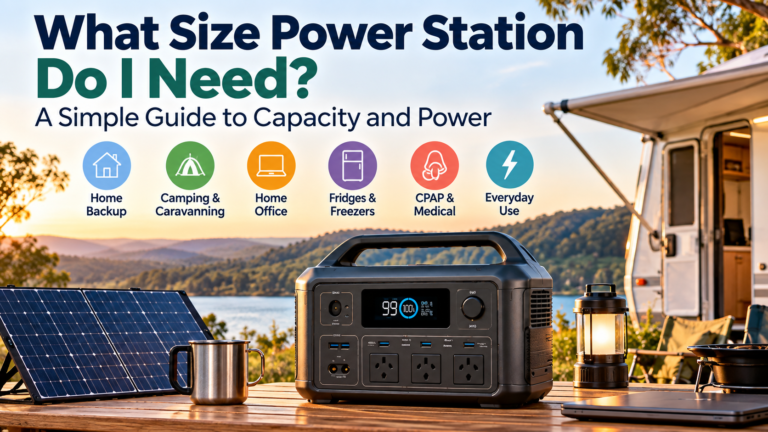
Portable Power Station for Refrigerator: What Size Do You Need?
How to Choose a Portable Power Station for a Refrigerator or Freezer
Introduction
A refrigerator or freezer is one of the most important appliances to keep running during a power outage. A portable power station can provide temporary backup electricity without requiring a petrol generator, but choosing the right one involves more than simply looking at the battery capacity.
You need to consider three separate things: how much power the refrigerator needs while running, how much power it may require when the compressor starts, and how much stored energy you need for the length of the outage.
This guide explains how to work out what size portable power station you need, how to estimate runtime, what to look for when comparing models, and which power stations are worth considering for refrigerator and freezer backup.
Whether you’re preparing for blackouts in Australia or power outages in the USA, the basic calculations are the same. The main difference is that you must buy a power station designed for the electrical system and outlets used in your country.
Can a Portable Power Station Run a Refrigerator or Freezer?
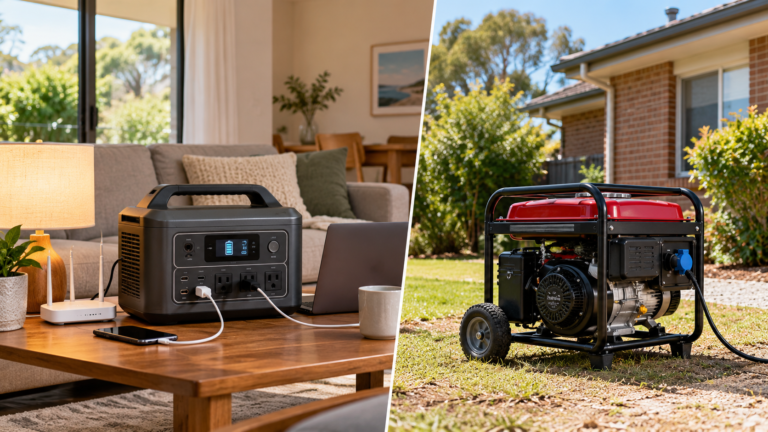
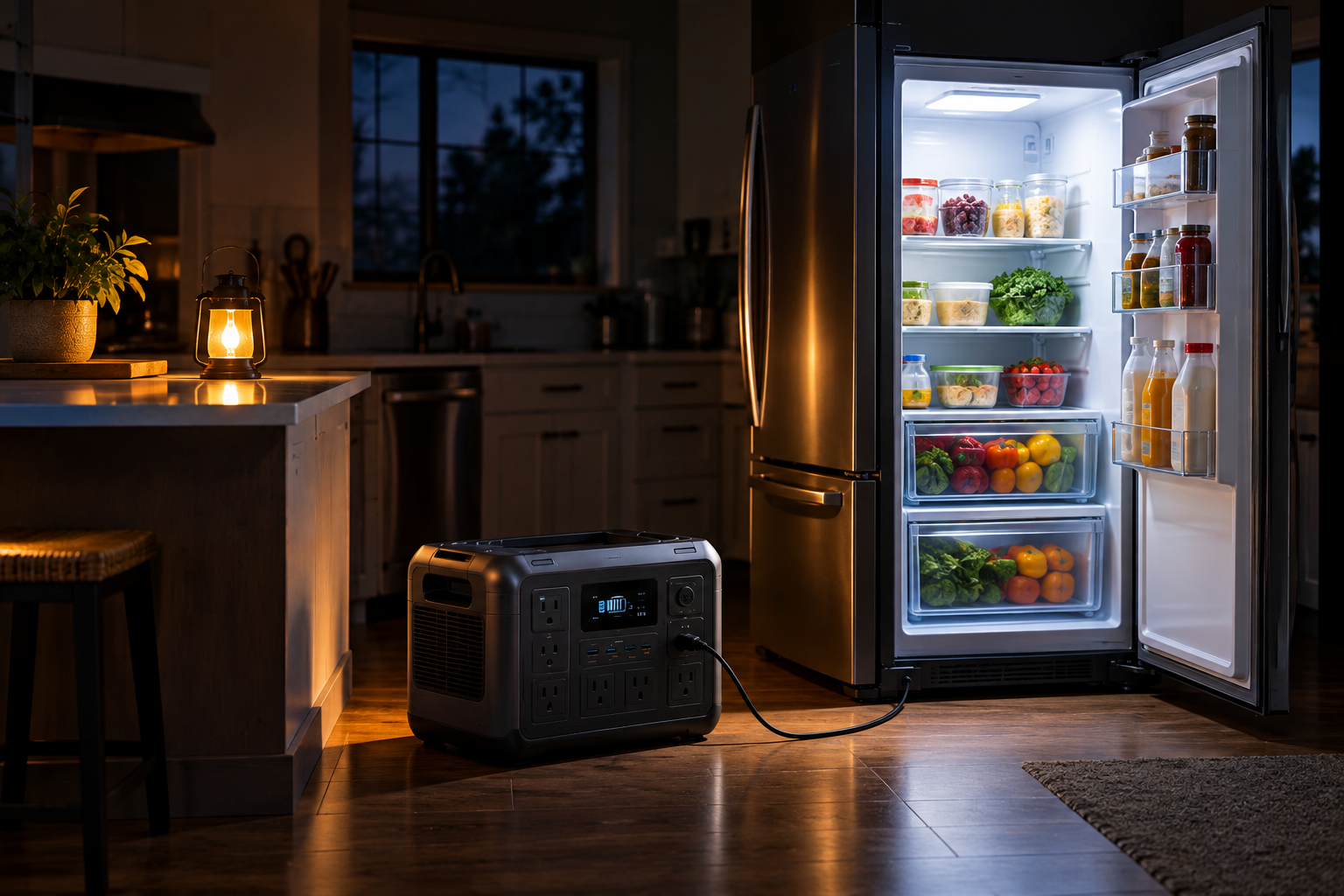
Yes. Many portable power stations have enough AC output to run a typical household refrigerator or freezer.
The important thing is to check both continuous output and starting or surge capability.
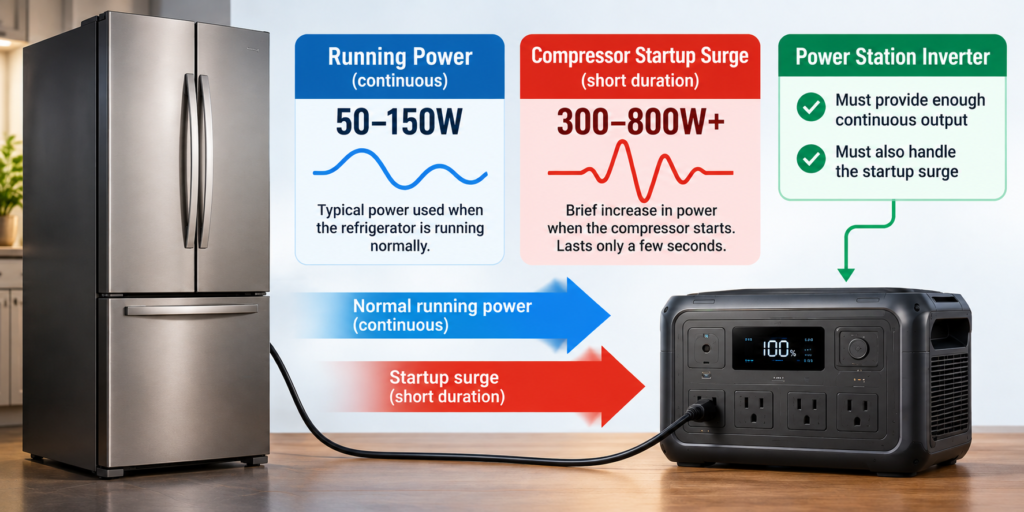
A refrigerator compressor cycles on and off rather than running continuously at its maximum power. When the compressor starts, however, the appliance can briefly require more power than it uses during normal operation.
This means a power station needs enough inverter output to handle the refrigerator’s starting requirements, as well as enough battery capacity to provide energy for the length of time you need.
A power station with a large battery is not automatically suitable if its inverter cannot handle the appliance’s starting demand.
Conversely, a power station with a very powerful inverter may be able to start the refrigerator easily but still run out of stored energy during a long outage.
How Much Electricity Does a Refrigerator Use?
Refrigerator electricity consumption varies considerably according to the size and design of the appliance, its efficiency, ambient temperature and how it is used.
In Australia, the Energy Rating Label provides an estimated annual electricity consumption in kilowatt-hours (kWh). The figure is based on standardised testing, so your actual consumption may be higher or lower.
If your refrigerator’s label says it uses 400kWh per year, you can estimate its average daily energy use like this:
400kWh ÷ 365 = approximately 1.10kWh per day
Because:
1kWh = 1,000Wh
that is approximately:
1,100Wh per day
This does not mean the refrigerator continuously draws 46 watts every hour. Refrigerators cycle their compressors on and off, so actual power consumption changes throughout the day.
The annual energy figure is therefore useful for estimating overall energy use, while a power meter can provide a better picture of the appliance’s actual consumption.
Running Watts vs Starting Watts
This is one of the most important things to understand before choosing a power station for a refrigerator.
Running watts
Running watts are the power the appliance requires while operating normally.
Starting watts
Starting watts, sometimes called surge watts, refer to the brief increase in power that some motors and compressors can require when they start.
A refrigerator may therefore have a relatively modest normal operating demand but require considerably more power for a short period when the compressor starts.
When comparing a power station, look at:
- Continuous AC output
- Surge or peak output
- Battery capacity
- Inverter type
- Manufacturer guidance about motor-driven appliances
If your refrigerator’s specifications don’t provide enough information about startup requirements, measuring the appliance with a suitable power meter can be useful.
Never assume that battery capacity alone tells you whether a power station can start a refrigerator.
How Many Watt-Hours Do You Need?
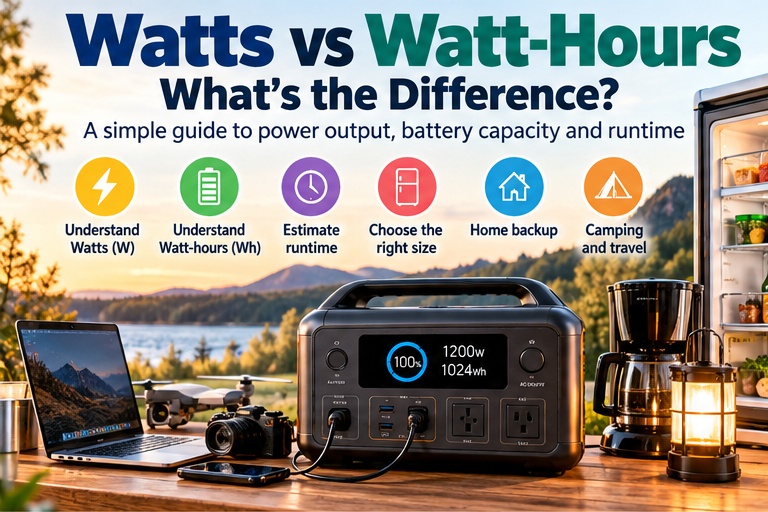
Portable power station capacity is normally expressed in watt-hours (Wh).
A larger Wh figure means the battery stores more energy, but it does not tell you exactly how long a refrigerator will run.
For example:
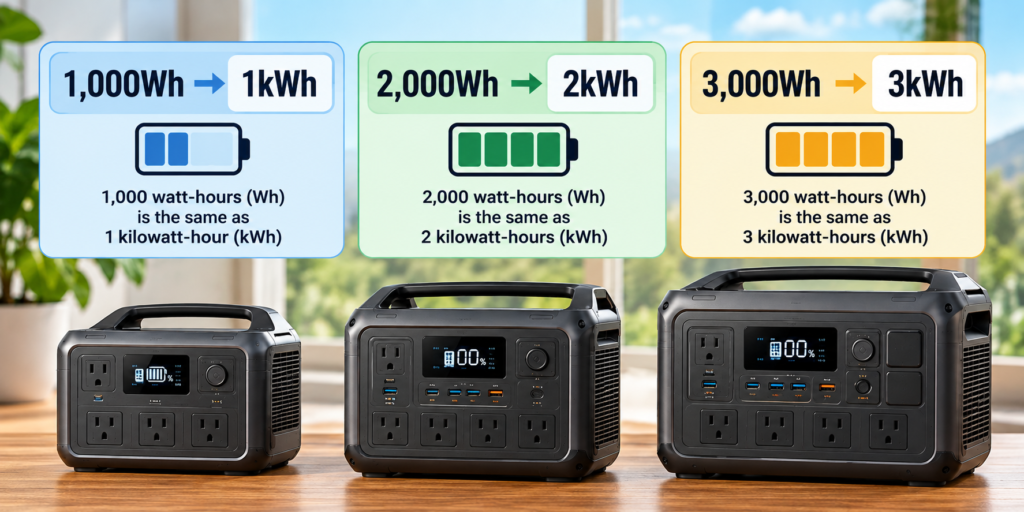
- 1,000Wh is approximately 1kWh
- 2,000Wh is approximately 2kWh
- 3,000Wh is approximately 3kWh
If your refrigerator uses an estimated 1.1kWh per day, a 1,000Wh battery does not necessarily provide exactly 24 hours of operation.
There are losses when DC battery energy is converted to AC electricity, and the power station itself consumes some energy while operating.
A practical estimate therefore needs to allow for efficiency and real-world conditions.
A simple starting calculation
Estimated runtime = usable battery energy ÷ average appliance consumption
For example, if a power station could deliver approximately 900Wh of usable AC energy and your refrigerator averaged 50W over the period being measured:
900Wh ÷ 50W = approximately 18 hours
This is only an illustration. Your refrigerator may have a very different average consumption.
For the most accurate estimate, use your refrigerator’s actual measured consumption rather than relying on a generic wattage figure.
How Long Will a Portable Power Station Run a Refrigerator?
There is no single runtime that applies to every refrigerator.
Runtime depends on:
- Battery capacity
- Refrigerator energy consumption
- Compressor cycling
- Inverter efficiency
- Power station standby consumption
- Ambient temperature
- How often the refrigerator door is opened
- Refrigerator size and efficiency
- Whether other appliances are connected
For this reason, statements such as “a 1,000Wh power station will run your fridge for 20 hours” should be treated cautiously.
A better approach is to calculate your own likely requirement.
If you know your refrigerator’s annual energy consumption, divide the annual figure by 365 to estimate average daily consumption.
If you have a suitable energy monitor, an even better approach is to measure the refrigerator over a representative period and use that real-world figure when planning backup capacity.
What Size Power Station Do You Need?
There is no universal size that suits every refrigerator.
The following ranges are useful as planning categories, rather than guarantees.
500–1,000Wh
A 500–1,000Wh power station can make sense for:
- Smaller refrigerators
- Short outages
- Emergency cooling
- Camping refrigerators
- Essential loads alongside limited refrigerator use
You still need to confirm that the inverter can handle the refrigerator’s startup requirements.
1,000–2,000Wh
This is a useful range for many household refrigerator-backup situations.
It provides more stored energy than the smallest portable units while remaining relatively portable.
It can also provide enough additional capacity for selected essentials such as:
- Wi-Fi equipment
- Phones
- Laptop
- Small lights
The actual runtime will depend on the refrigerator and the other loads connected.
2,000–3,000Wh
A 2,000Wh-class system becomes more attractive when you want longer backup or need to run a refrigerator together with additional essential loads.
It can also provide more flexibility when an outage lasts considerably longer than expected.
Again, battery capacity is only part of the equation. The inverter must still have sufficient output for the connected appliances.
3,000Wh and Above
Larger systems become useful when you want to support multiple essential appliances for extended periods.
They may also be expandable, allowing additional batteries to be added later.
At this point, however, you’re moving from a simple portable refrigerator backup solution toward a more substantial home-backup system.
For broader home-backup planning, see our guide to [Best Portable Power Station for Home Backup].
Running a Refrigerator and Freezer Together
Running a refrigerator and separate freezer from the same power station increases the energy requirement.
You need to consider:
- The running demand of both appliances.
- The startup requirements of both compressors.
- Whether both compressors could start at approximately the same time.
- The total energy required over the intended backup period.
A power station that comfortably handles one refrigerator may not provide enough stored energy for a refrigerator and freezer during a long outage.
For longer outages, an expandable power station can provide additional flexibility.
What Else Can You Run During a Power Outage?
A refrigerator is rarely the only appliance people need during a blackout.
You may also want to maintain:
- Wi-Fi/NBN equipment
- Mobile-phone charging
- Laptop
- LED lighting
- Medical or CPAP equipment
- Television or radio
- Small fans
- Selected kitchen appliances
Every additional load reduces the available runtime.
If you’re planning to power several essential household loads, calculate their approximate energy requirements together rather than choosing a power station based solely on the refrigerator.
For a broader look at home backup, see [Best Portable Power Station for Home Backup].
Portable Power Stations for Refrigerator Backup
As an Amazon Associate I earn from qualifying purchases.
The following models illustrate different battery and output classes that can be considered when planning refrigerator or freezer backup.
Important: Always confirm the exact model, regional version, current specifications and Amazon listing before purchasing.
EcoFlow DELTA 3 Plus
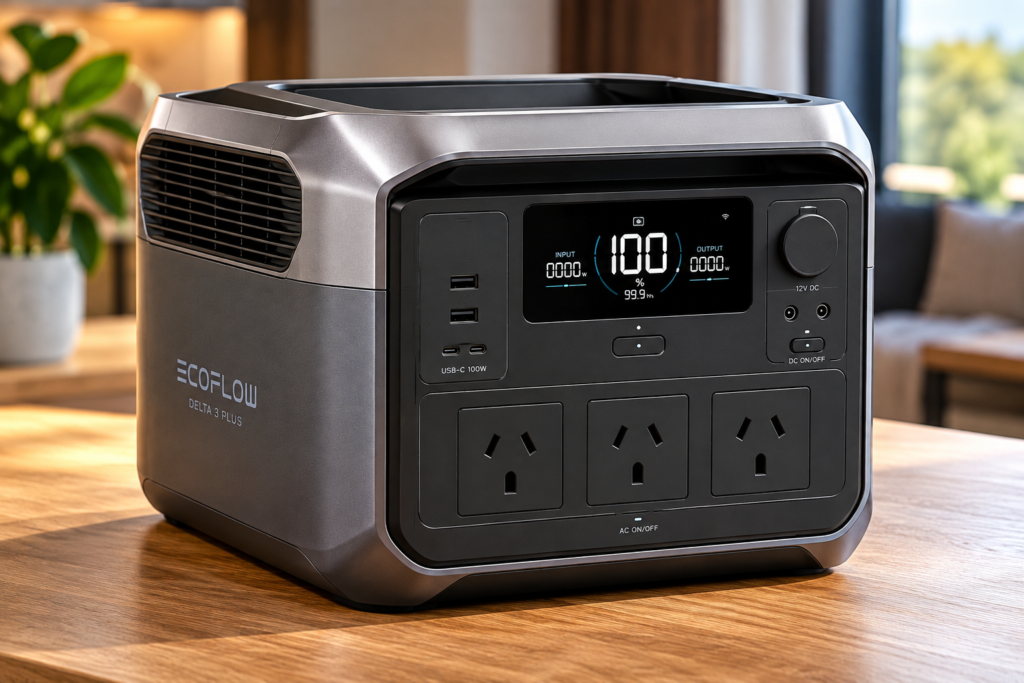
The EcoFlow DELTA 3 Plus has a 1,024Wh battery capacity and 1,800W of continuous AC output. EcoFlow lists 2,400W X-Boost output and up to 1,000W solar input, with expandable capacity from 1kWh to 5kWh using compatible batteries.
Its 1kWh-class capacity makes it a useful example for households looking for a relatively compact backup system rather than a large home battery.
It can also be expanded when additional stored energy is required.
Best for: Refrigerator backup, shorter outages, camping and buyers wanting a relatively compact 1kWh-class power station.
Anker SOLIX C1000
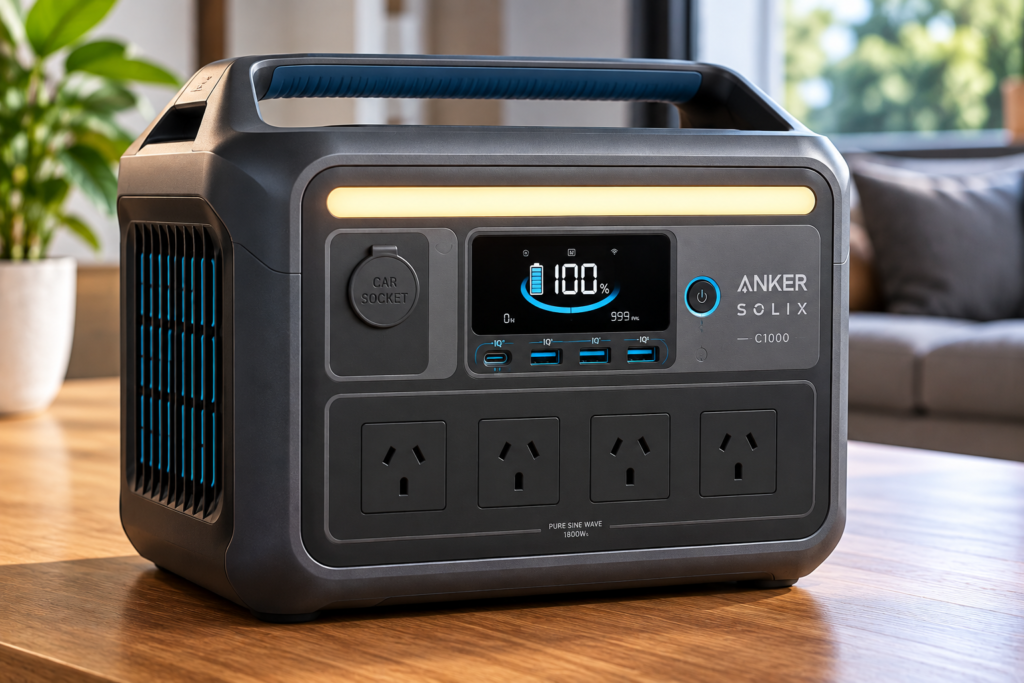
The original Anker SOLIX C1000 has a 1,056Wh LiFePO4 battery and 1,800W of continuous pure-sine-wave AC output, with a 2,400W surge rating and up to 600W solar input. Anker also lists expansion to 2,112Wh with the compatible expansion battery.
Its combination of battery capacity and inverter output makes it a useful 1kWh-class option for refrigerator backup, while expansion provides a way to increase stored energy if longer runtime is needed.
Best for: Short blackouts, refrigerator backup, camping and buyers wanting expandable 1,000Wh-class storage.
DJI Power 1000 V2
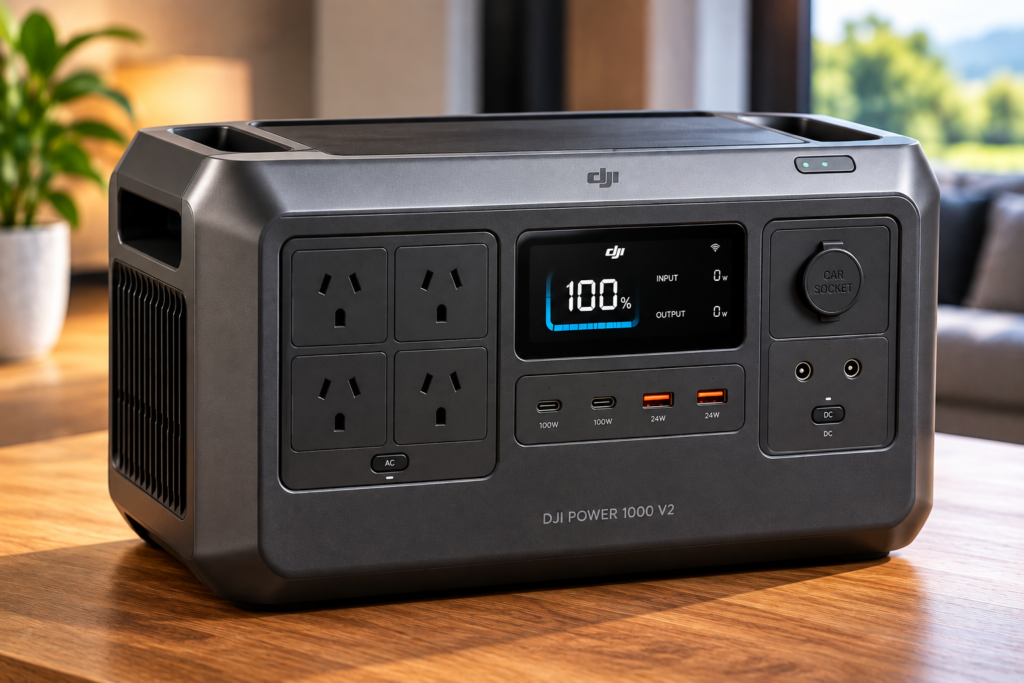
The DJI Power 1000 V2 has a 1,024Wh battery and 2,600W continuous output. DJI says it can connect to up to five expansion batteries, taking total capacity to 11,264Wh. It also supports grid, solar and car charging and can recharge fully in approximately 56 minutes under the manufacturer’s stated charging conditions.
The relatively high inverter output compared with its 1kWh battery capacity makes it an interesting option where appliance startup and high instantaneous loads need to be considered.
Best for: Buyers wanting high AC output from a roughly 1kWh-class system and the option to expand later.
DJI Power 2000
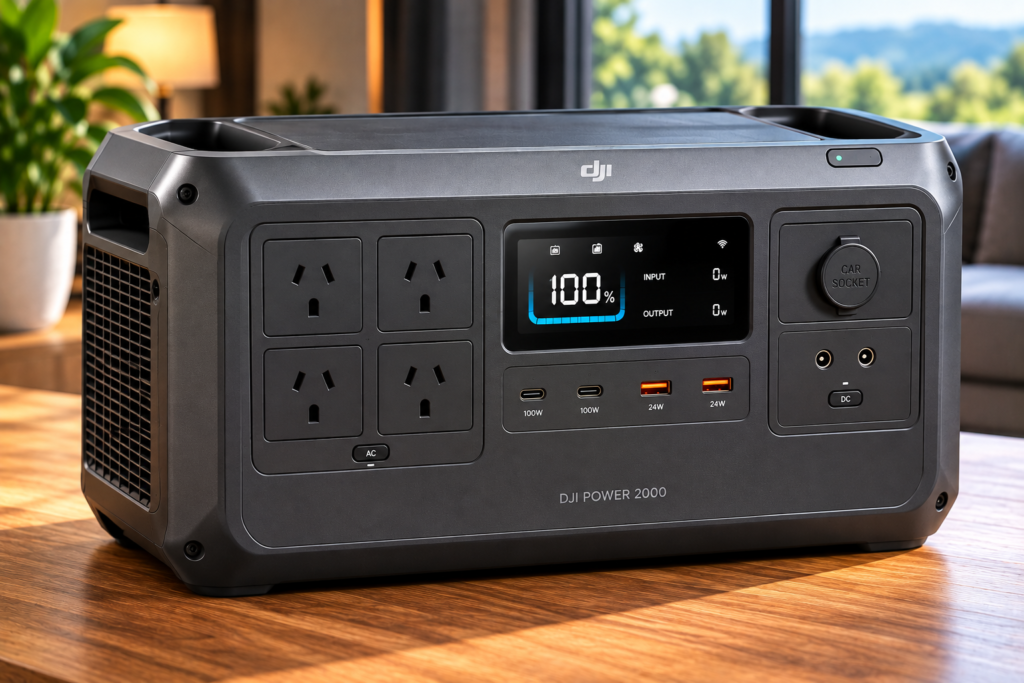
The DJI Power 2000 moves into the 2kWh class with a 2,048Wh battery and 3,000W continuous AC output. DJI says the system can be expanded to as much as 22,528Wh using compatible expansion batteries.
DJI specifically describes the Power 2000 as capable of powering household appliances including refrigerators.
This larger battery capacity can make it more suitable when refrigerator backup needs to last longer or when additional essential loads need to be supported.
Best for: Longer refrigerator or freezer backup and households wanting more stored energy for additional essential loads.
How to Calculate Your Own Refrigerator Runtime
The most useful calculation is based on your refrigerator’s actual energy consumption.
Start by finding the refrigerator’s annual energy consumption.
In Australia, this can usually be found on the Energy Rating Label.
For example:
Annual consumption: 400kWh
Calculate:
400 ÷ 365 = 1.10kWh per day
Convert to watt-hours:
1.10 × 1,000 = approximately 1,100Wh per day
You can then compare this requirement with the usable AC energy available from your power station.
Remember that the power station’s advertised battery capacity is not the same as the amount of AC energy you will necessarily receive from its outlets.
For planning purposes, use conservative estimates rather than assuming 100% of the advertised battery capacity will be available to your appliance.
How to Find Your Refrigerator’s Actual Energy Use
The best way to understand your refrigerator’s real consumption is to measure it.
A suitable electricity monitor can measure how much energy the refrigerator consumes over time.
For the most useful result:
- Connect the refrigerator through the meter.
- Leave it operating normally.
- Measure over a sufficiently long period to capture compressor cycling.
- Avoid drawing conclusions from only a few minutes of data.
- Use the measured energy consumption to estimate backup requirements.
This is particularly useful for older refrigerators, large refrigerators and appliances operating in hot environments.
Australian Energy Rating information also explains that standardised label consumption figures are estimates and that actual use can be higher or lower depending on how the appliance is used.
How Solar Can Extend Refrigerator Backup
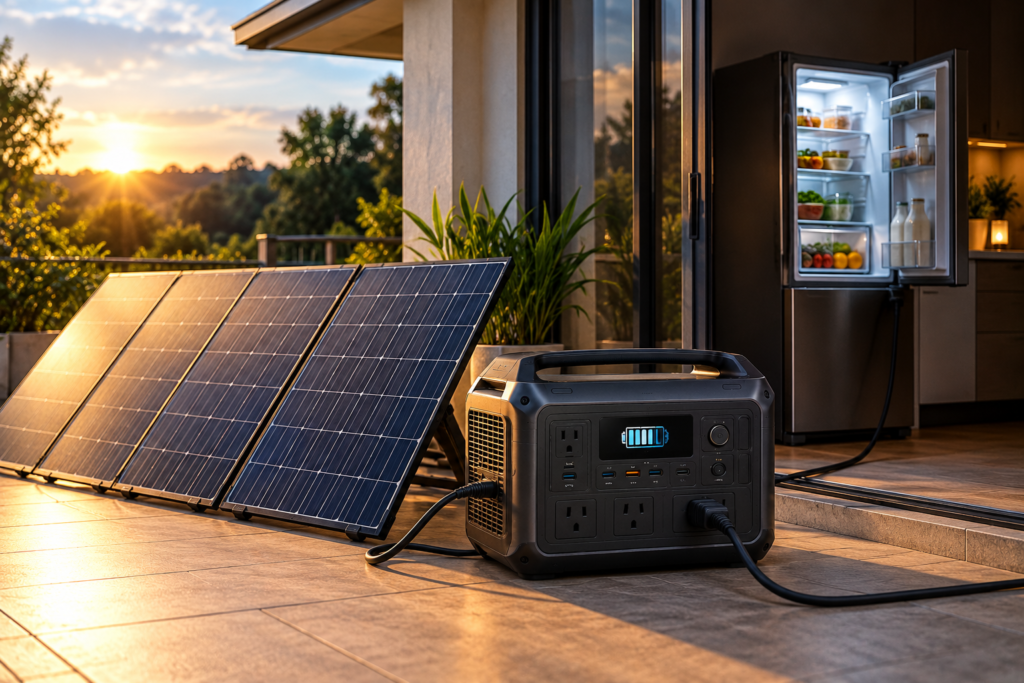
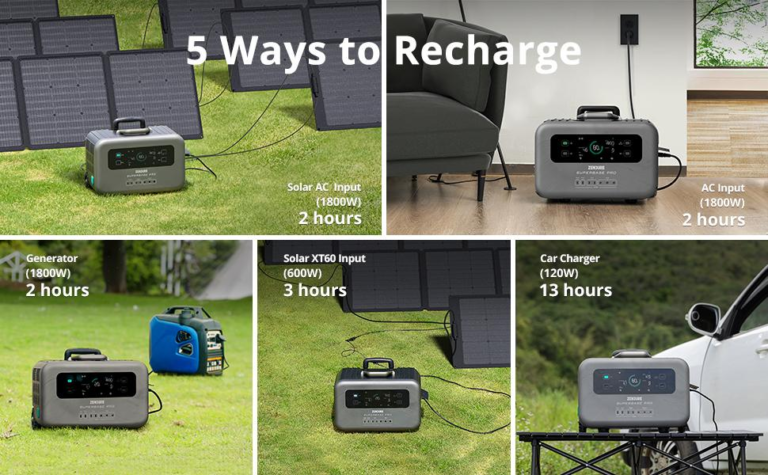
Solar panels can extend the amount of time a portable power station can support a refrigerator, provided the solar input and conditions are suitable.
During daylight, solar energy can:
- Recharge the battery
- Offset some of the refrigerator’s consumption
- Reduce the rate at which the battery is depleted
- Potentially extend backup during a prolonged outage
Solar output varies with:
- Sunlight
- Cloud cover
- Panel orientation
- Temperature
- Shading
- Panel specifications
- Power-station solar-input limits
Do not assume a panel will continuously deliver its advertised maximum output.
For longer outages, solar can be particularly useful because it provides an additional source of energy rather than relying entirely on the initial battery charge.
Refrigerator Backup During an Extended Outage
A power station is only one part of blackout preparation.
Keep the refrigerator and freezer doors closed as much as possible.
FoodSafety.gov states that an unopened refrigerator generally keeps food cold for about 4 hours, while a full freezer can hold its temperature for approximately 48 hours, or about 24 hours if half full, when the door remains closed.
Use an appliance thermometer where appropriate so you can monitor temperatures rather than relying on guesswork.
If an outage is prolonged, follow current food-safety guidance for deciding what should be kept or discarded.
A portable power station can help maintain refrigeration, but it does not guarantee that food remains safe. Temperature and food-handling guidance still applies.
Australia vs USA: Check the Correct Power Station Version
Portable power stations are not necessarily identical in every market.
Electrical voltage, frequency, AC outlets and regional model numbers can differ.
For example, DJI identifies different Power 2000 regional versions, with the US model using 100–120V output and the higher-voltage model using 220–240V output.
Australian buyers should therefore purchase the Australian version intended for Australian mains appliances.
US buyers should purchase the US version intended for the US electrical system.
Do not assume that a power station bought in one country is automatically suitable for appliances or outlets in another.
Safety: Never Backfeed Household Wiring
Portable power stations are generally designed to supply selected appliances through their available outlets.
Do not attempt to energise household wiring by plugging a power station into a standard wall outlet.
This can create dangerous backfeed conditions.
If you want a portable power station or battery system integrated with household electrical circuits, use compatible equipment and have the installation carried out by a suitably qualified electrician where required.
For simple backup, connect the appliances you need directly to the power station according to the manufacturer’s instructions.
Portable Power Station Comparison
| Product | Battery Capacity | Continuous AC Output | Solar Input | Expansion |
|---|---|---|---|---|
| EcoFlow DELTA 3 Plus | 1,024Wh | 1,800W | Up to 1,000W | 1–5kWh |
| Anker SOLIX C1000 | 1,056Wh | 1,800W | Up to 600W | Up to 2,112Wh |
| DJI Power 1000 V2 | 1,024Wh | 2,600W | Regional/accessory dependent | Up to 11,264Wh |
| DJI Power 2000 | 2,048Wh | 3,000W | Regional/accessory dependent | Up to 22,528Wh |
Frequently Asked Questions
Can a 1,000Wh power station run a refrigerator?
It can, depending on the refrigerator’s energy consumption and the power station’s AC output and surge capability.
Battery capacity determines how much energy is stored, while inverter output determines whether the power station can supply the appliance’s instantaneous power requirements.
Always check both before purchasing.
How long will a 2,000Wh power station run a refrigerator?
There is no single runtime because refrigerators use different amounts of energy and their compressors cycle on and off.
A 2,000Wh power station stores approximately twice as much energy as a 1,000Wh power station, but actual AC runtime will be lower than the headline capacity and will depend on the refrigerator’s consumption and the power station’s efficiency.
For a useful estimate, measure the refrigerator’s actual energy consumption where possible.
Can a portable power station run a freezer?
Yes, provided the power station has sufficient continuous and starting output and enough stored energy for the required runtime.
A freezer’s actual energy consumption should be used when estimating how much battery capacity is required.
Can I run a refrigerator and freezer from the same power station?
Yes, if the power station has sufficient inverter output and battery capacity for both appliances.
Remember to consider the possibility of both compressor-driven appliances starting around the same time.
For longer outages, additional battery capacity may be useful.
Does a refrigerator need a pure sine wave inverter?
A refrigerator is an appliance with a motor-driven compressor, so using a power station with a pure sine wave AC output is a sensible choice.
Always follow the refrigerator and power-station manufacturer’s instructions.
Should I buy a larger power station than I think I need?
Allowing some capacity margin can be useful, particularly if you expect to run additional essential loads or want backup to last through a longer-than-expected outage.
However, buying a much larger system isn’t automatically better. Larger systems generally cost more and can be heavier and less convenient to move.
Choose a capacity based on your actual loads and the backup period you are trying to cover.
Can solar panels keep my refrigerator running during a blackout?
Solar panels can help recharge a compatible power station and extend available backup energy.
Actual solar production depends on weather, sunlight, panel orientation, shading and the power station’s solar-input limits.
Solar should therefore be treated as an additional energy source rather than a guarantee of continuous refrigerator operation.
Can I plug a portable power station into a wall outlet to power my house?
No. Never attempt to backfeed household wiring through a standard wall outlet.
If you want a battery system connected to household circuits, use appropriate equipment and professional electrical installation where required.
Final Verdict
Choosing a portable power station for a refrigerator or freezer is mainly a matter of matching power output, starting capability and battery capacity to your particular appliance.
A 1,000Wh-class power station can be a practical starting point for some refrigerator-backup situations, while a 2,000Wh-class system provides more stored energy for longer outages or additional essential loads.
The most reliable way to choose is to check your refrigerator’s energy consumption, consider its compressor startup requirements and then calculate how much backup energy you actually need.
For shorter outages and portable use, the EcoFlow DELTA 3 Plus and Anker SOLIX C1000 provide examples of compact 1kWh-class systems. The DJI Power 1000 V2 offers higher inverter output in a similar battery-capacity class, while the DJI Power 2000 provides approximately twice the battery capacity for situations where longer backup is important.
Before purchasing, always confirm the exact regional version, AC voltage and outlets, current specifications, available expansion batteries and current Amazon availability.