Watts vs Watt-Hours: What’s the Difference?
Introduction
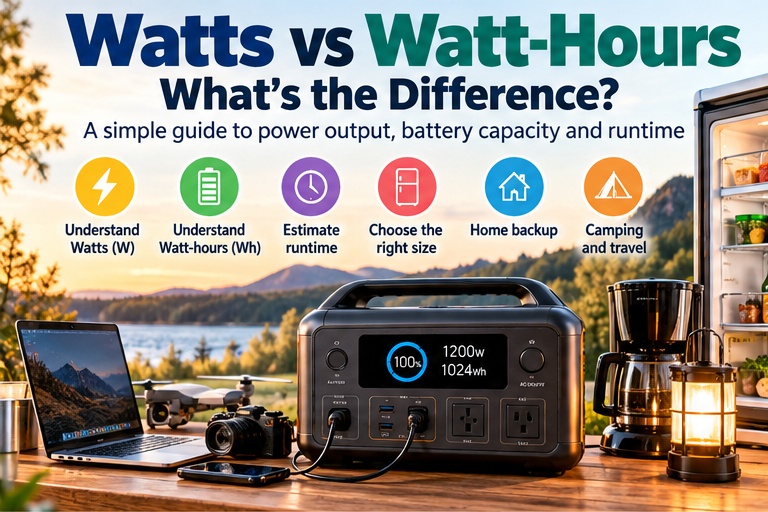
Watts vs watt-hours can be confusing when you are comparing portable power stations.
Although both measurements are important, they describe different things. Watts (W) measure power, while watt-hours (Wh) measure energy.
Understanding the difference can help you choose a portable power station that has enough power to run your appliances and enough battery capacity to keep them operating for the time you need.
What Are Watts?
Watts measure power.
In a portable power station, the watt rating tells you how much electrical power the unit can provide to connected devices at a particular time.
For example, if a portable power station has a continuous output rating of 1,000W, it is designed to supply up to approximately 1,000 watts of power continuously, subject to the manufacturer’s specifications.
A device that uses 100W requires less output from the power station than a device that uses 800W.
This is why the watt rating is important when deciding whether a power station can operate a particular appliance.
What Are Watt-Hours?
Watt-hours measure energy.
The watt-hour rating of a portable power station indicates how much energy its battery can store.
For example, a power station rated at 1,000Wh has a battery capacity of 1,000 watt-hours under the manufacturer’s rated conditions.
A simple way to think about it is:
Watts = how much power something uses
Watt-hours = how much energy is stored or used over time
This distinction is particularly important when estimating how long a portable power station will run your equipment.
The Australian Government’s energy guidance explains battery capacity and power output in more detail, which can be useful when comparing energy storage systems.
Watts vs Watt-Hours: The Simple Difference
The easiest way to remember the difference is:
| Measurement | What it tells you | Example |
|---|---|---|
| Watts (W) | How much power a device needs or a power station can supply | 500W |
| Watt-hours (Wh) | How much energy a battery stores | 1,000Wh |
Think of watts as the size of the electrical load and watt-hours as the amount of energy available to supply that load over time.
You need to consider both when choosing a portable power station.
Why Watts Matter When Choosing a Power Station
The power station needs enough output to operate the equipment you want to connect.
For example, imagine you want to run these devices at the same time:
- Laptop: 60W
- Monitor: 40W
- Wi-Fi equipment: 15W
- Lights: 20W
The estimated combined load would be:
60W + 40W + 15W + 20W = 135W
A power station with a continuous output rating well above this figure would have enough output capacity for this particular example.
However, you also need to consider whether any equipment has a higher starting or surge requirement.
Continuous Power vs Surge Power
Portable power stations often provide two different output figures:
Continuous output is the amount of power the power station can provide during normal operation.
Surge or peak output is the higher amount of power it may temporarily provide when equipment starts.
This matters because some appliances require extra power when they start.
Refrigerators, freezers, pumps and other equipment containing motors or compressors can have higher starting requirements than their normal running wattage.
Always check the manufacturer’s specifications for both the appliance and the power station.
Why Watt-Hours Matter
Watt-hours become particularly important when you want to know how long your power station can run your equipment.
For example, suppose a device uses approximately 100W and you want to operate it for four hours.
The basic calculation is:
100W × 4 hours = 400Wh
So the equipment would require approximately 400Wh of energy before allowing for losses and other factors.
A power station with a larger Wh capacity can generally provide more energy over time, although actual usable capacity and runtime vary between models.
How to Calculate Runtime
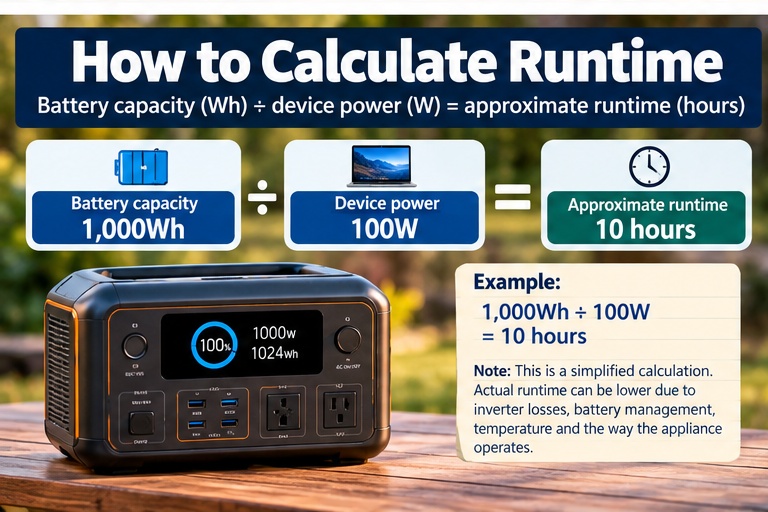
A simple starting calculation is:
Battery capacity (Wh) ÷ device power (W) = approximate runtime in hours
For example:
1,000Wh ÷ 100W = 10 hours
However, this is a simplified calculation.
Portable power stations are not 100% efficient, and the actual runtime can be affected by inverter efficiency, battery management, temperature, battery condition and the way the appliance operates.
For that reason, the manufacturer’s runtime information can be useful when comparing specific models.
A Real-World Example
Imagine you have a 1,000Wh portable power station and want to operate a laptop that uses approximately 60W.
The simple calculation would be:
1,000Wh ÷ 60W = approximately 16.7 hours
In real-world use, the actual operating time would generally be lower because of conversion losses and the way the power station manages its battery.
The example demonstrates the important relationship between the two measurements:
The 60W figure describes the power being used.
The 1,000Wh figure describes the stored energy available.
What Happens If the Watts Are Too High?
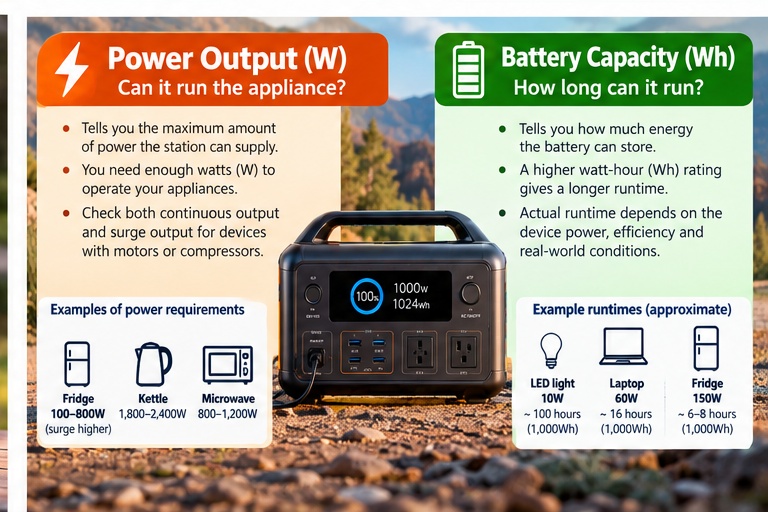
A power station can have a large battery capacity but still be unsuitable for an appliance if its output rating is too low.
For example, a power station might have a large battery but only be capable of supplying 500W continuously.
If you connect an appliance requiring significantly more than 500W, the power station may not be able to operate it, even though plenty of battery capacity remains.
This is why you should never choose a portable power station based on Wh capacity alone.
What Happens If the Watt-Hours Are Too Low?
The opposite problem can also occur.
A power station may have enough output to operate an appliance but not enough battery capacity to run it for the length of time you need.
For example, a power station might be capable of supplying 1,500W but have a relatively small battery.
It could operate a high-power appliance, but the battery could be depleted relatively quickly.
This is why power output and battery capacity need to be considered together.
Watts and Watt-Hours for Different Uses
Different applications place different demands on a portable power station.
Phones, Tablets and Small Electronics
These devices generally require relatively little power.
A smaller power station may provide enough capacity for charging phones, tablets and other small electronics, depending on how many devices you need to charge and how often.
Home Office
A home office might include:
- Laptop or desktop computer
- Monitor
- Wi-Fi router
- NBN equipment
- Phone charger
- Desk lighting
For this type of setup, calculate the combined wattage and then estimate how many hours you need the equipment to operate.
Refrigerator or Freezer
Refrigerators and freezers require additional consideration because their compressors cycle on and off and can have higher starting requirements.
You need to check both the power station’s output capability and its battery capacity.
For more information, see our Refrigerator & Freezer Backup guide.
Camping and Caravanning
Camping requirements can range from simply charging phones and running lights to operating refrigerators, coffee makers, televisions and other appliances.
A larger Wh capacity may be useful for longer trips, while sufficient W output is needed for appliances with higher power requirements.
Does a Higher Watt Rating Mean a Better Power Station?
Not necessarily.
A higher watt rating simply means the power station is designed to supply a greater amount of power, subject to its specifications.
You may not need a very high output rating if you only intend to operate low-power devices.
Likewise, a high output rating does not automatically mean the battery will last longer.
When comparing power stations, consider:
- Continuous output
- Surge output
- Battery capacity
- Usable capacity
- Charging options
- Weight Portability
- The appliances you actually need to operate
Does a Higher Wh Rating Mean a Better Power Station?
Again, not necessarily.
A higher Wh rating means more stored energy, but a larger battery can also mean a heavier and more expensive unit.
The right capacity depends on how you intend to use the power station.
Someone who mainly wants emergency phone charging may have very different requirements from someone who wants to keep a refrigerator, Wi-Fi equipment and essential lighting operating during a blackout.
Watts vs Watt-Hours: What Should You Look At First?
Look at both.
Start with the equipment you want to operate.
Then determine:
- How many watts each device requires.
- Whether any device has a high starting or surge requirement.
- How many devices may operate simultaneously.
- How many hours you need them to operate.
- How much battery capacity you are likely to need.
- How you will recharge the power station.
This approach is more useful than choosing a power station based on its largest number on the product box.
A Simple Example
Suppose your emergency backup equipment consists of:
- Wi-Fi router: 15W
- Laptop: 60W
- LED lighting: 20W
- Phone charging: 10W
The combined estimated load is:
15W + 60W + 20W + 10W = 105W
If these devices were operating continuously for five hours:
105W × 5 hours = 525Wh
You would then allow additional capacity for real-world losses and variations in power consumption.
This gives you a starting point for comparing different power station capacities.
Final Thoughts
Understanding watts vs watt-hours makes it much easier to compare portable power stations.
Remember the basic difference:
Watts (W) tell you how much power is required or supplied.
Watt-hours (Wh) tell you how much energy is stored or used over time.
You need enough W to operate your appliances and enough Wh to run them for the amount of time you require.
Once you understand these two measurements, you can make much more meaningful comparisons between portable power stations for camping, caravanning, home backup, refrigerators, home offices and everyday use.
For a broader explanation of choosing the right portable power station, see our Portable Power Station Buying Guide.