Portable Power Station vs Generator: Which Is Better for Home Backup?
When choosing backup power for your home, a portable power station and a conventional fuel generator can both provide electricity during a blackout. However, they work in different ways, have different running costs and suit different situations.
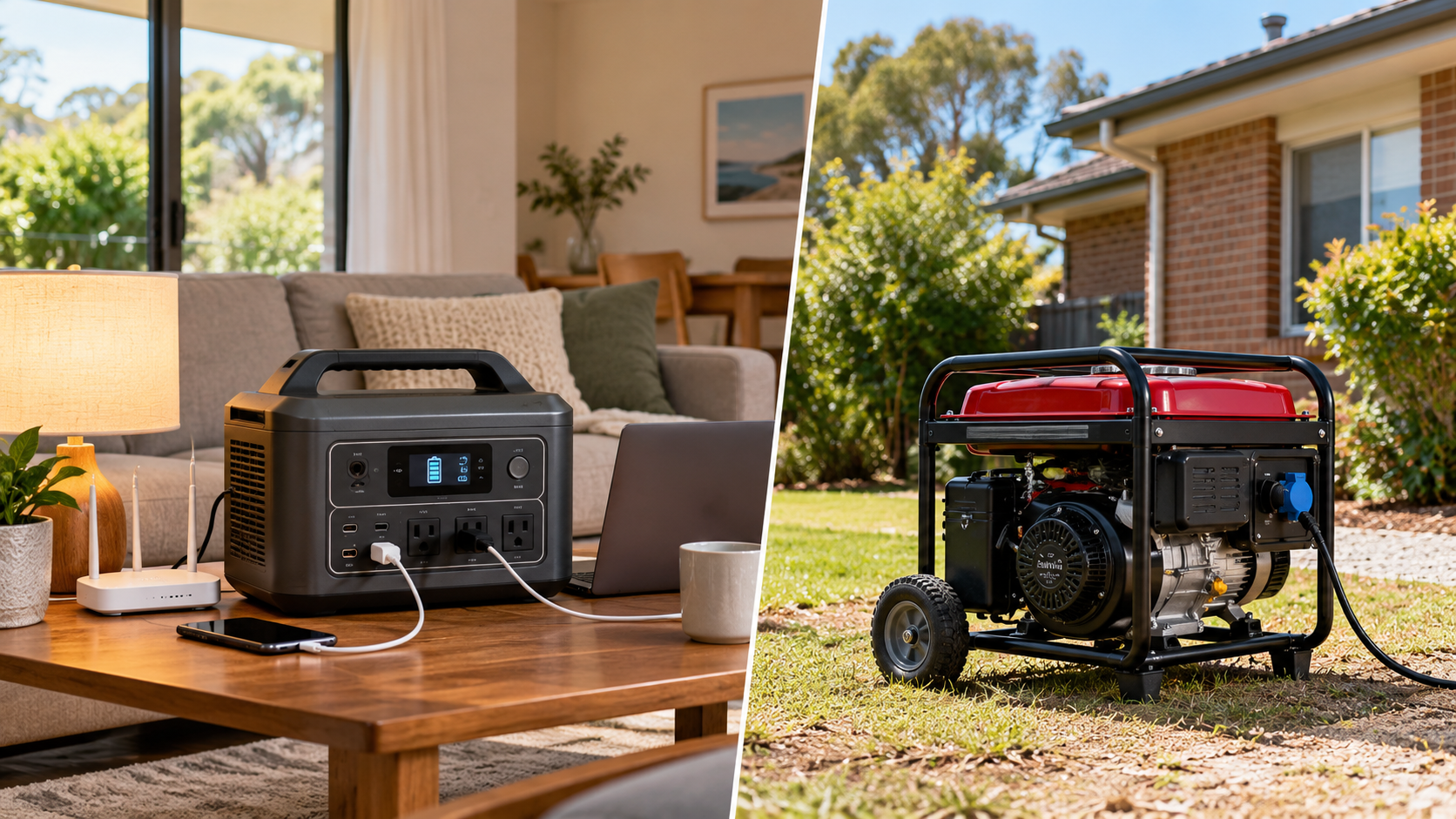
A portable power station stores electricity in a rechargeable battery. A generator produces electricity by running an engine on fuel. One offers quiet, convenient battery power for selected devices, while the other can provide a continuing supply of electricity for as long as it has fuel and is operated within its limits.
So, which is better for your home? The answer depends on the appliances you need to run, the expected length of a power outage, where the equipment can be operated safely and how you plan to replenish its energy supply.
This guide compares both options for Australian households, explaining the main differences so you can choose a practical backup solution rather than simply buying the most powerful equipment.
Table of Contents
Portable Power Station vs Generator: The Quick Answer
A portable power station is generally a good choice when you want quiet, convenient backup electricity for essential electronics, lighting, communications equipment and selected appliances during a short outage. It can also be useful when you want to recharge from compatible solar panels.
A fuel-powered generator may be better suited to longer outages and sustained higher-power demands, provided you can operate it outdoors safely, manage the fuel supply and maintain the equipment.
Neither option is automatically the best choice for every household.
A portable power station has a finite amount of stored energy, so its runtime depends on battery capacity, the equipment being powered and opportunities to recharge. A generator can continue producing electricity while it has fuel, but it requires safe outdoor operation and regular attention.
Before deciding, consider these questions:
- Which appliances and devices are essential during a blackout?
- How much power do those appliances require?
- How long might the outage last?
- Can you operate a generator safely outdoors?
- Is solar charging practical for your location?
- What are your upfront budget and ongoing running costs?
Answering these questions will help you choose the option that best matches your circumstances.
How a Portable Power Station and a Generator Work
Although both can provide electricity when the mains supply is unavailable, their energy sources are different.
How a portable power station works
A portable power station stores energy in an internal rechargeable battery. An inverter converts stored battery power into AC electricity for compatible household appliances, while USB and DC outputs can supply other devices.
Depending on the model, charging options may include mains electricity, compatible solar panels, vehicle charging or another supported power source.
The main advantage is convenience. There is no fuel-burning engine producing exhaust at the point of use, and many models can operate indoors when used in accordance with the manufacturer’s instructions.
The main limitation is stored energy. Once the usable battery capacity is depleted, the power station must be recharged before it can continue supplying power from its battery.
A larger battery can extend the available operating time, but it does not automatically mean the unit can power every appliance. You still need to check the continuous AC output and any starting or surge requirements.
How a portable generator works
A conventional portable generator uses an engine to turn an electrical generator, producing electricity while the engine is operating.
Depending on the model, the engine may use petrol, diesel or another fuel specified by the manufacturer.
Because the generator produces electricity while running, it can be useful when an outage lasts many hours or several days. Runtime is not limited to the energy stored in a battery, although fuel capacity, safe refuelling, maintenance requirements and operating conditions all matter.
A generator also introduces additional responsibilities. It produces exhaust, makes engine noise, requires fuel storage and must be operated according to the manufacturer’s safety instructions.
A portable generator must never be operated inside a home, garage, caravan or another enclosed or partially enclosed space.
Portable Power Station vs Generator: Main Differences
The following comparison summarises the main practical differences.
| Feature | Portable power station | Fuel generator |
|---|---|---|
| Energy source | Stored rechargeable battery | Fuel consumed by an engine |
| Runtime | Limited by usable battery energy and recharging | Can continue running while fuel is available, subject to operating limits |
| Noise | Generally quiet, although cooling fans may be audible | Produces engine noise |
| Exhaust at the point of use | No fuel-engine exhaust | Produces exhaust and carbon monoxide |
| Indoor operation | Many models can be used indoors according to their instructions | Must be operated outdoors, away from openings |
| Recharging or refuelling | Mains, compatible solar panels or other supported charging methods | Requires the correct fuel |
| Maintenance | Battery care and manufacturer-prescribed checks | Engine servicing, fuel management and other maintenance |
| Portability | Depends on battery capacity, size and weight | Depends on generator size, weight and fuel requirements |
| Longer outages | May need repeated recharging or additional compatible batteries | Can provide continuing output if fuel and safe operating conditions are available |
| Solar integration | Available on compatible models and with suitable panels | Conventional fuel generators generally depend on fuel rather than solar input |
| Best suited to | Quiet backup for selected devices and appliances | Sustained power demands where safe outdoor operation is practical |
These are general comparisons. Actual capabilities vary by model, so check the manufacturer’s specifications before making a purchase.
Which Option Can Run Your Appliances?
One of the most important considerations is the equipment you need to keep operating during an outage.
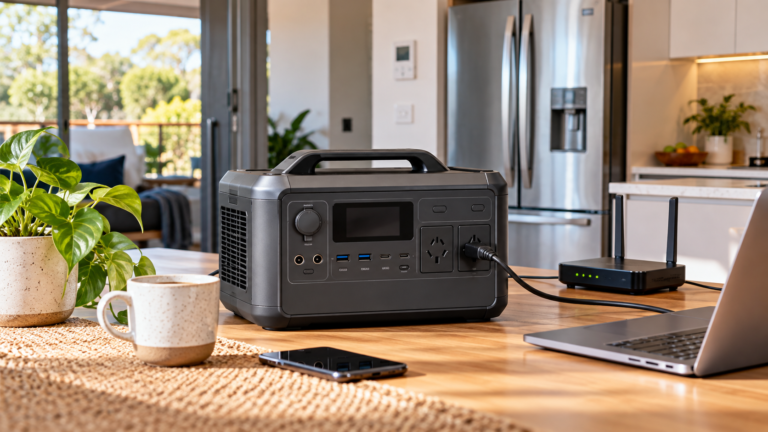
A small portable power station may be perfectly adequate for charging phones, powering a Wi-Fi router and running LED lighting. The same unit may be unsuitable for a high-wattage kettle, microwave or refrigerator if its output or starting capability is insufficient.
A larger power station can provide more capacity, but its continuous AC output still needs to meet the appliances’ requirements.
Generators also have output limits. A generator must be able to supply the combined load of the appliances operating at the same time, including any additional starting demand from motors and compressors.
Before connecting equipment to either option, check:
- The appliance’s rated electrical power.
- Its starting or surge requirement, where applicable.
- The total wattage of appliances that may operate simultaneously.
- The continuous output and surge capability of the backup equipment.
- Any manufacturer restrictions on the intended appliances.
Our guide to what a portable power station can run explains appliance compatibility in more detail.
For generators, the Queensland Electrical Safety Office also provides guidance on portable generator specifications and powering appliances.
Runtime: How Long Can Each Option Provide Power?
Runtime can make a substantial difference when choosing between these two options.
Portable power station runtime
A portable power station can only supply the energy available from its usable battery capacity and any additional energy it receives while operating.
For example, a high-capacity battery may run low-power electronics for a considerable time. A high-wattage appliance may consume the available energy much more quickly.
Actual runtime depends on:
- Usable battery capacity.
- The power consumption of connected appliances.
- Inverter and conversion losses.
- The power station’s own energy consumption.
- Changes in appliance demand.
- Whether the battery can be recharged during the outage.
The most useful approach is to estimate the energy needed for your essential appliances and compare that figure with the power station’s usable capacity.
Our guide to choosing the right power station size explains how to estimate both power requirements and battery capacity.
Generator runtime
A generator produces electricity while its engine runs. Depending on the model and load, its fuel tank may provide several hours of operation before refuelling is required.
Actual fuel consumption varies with generator design, load, fuel type and operating conditions. Check the manufacturer’s information for the expected fuel use and permissible operating periods.
A generator can be useful during extended outages when a battery alone would need frequent recharging. However, the fuel supply must be available, the generator must be operated safely and the required maintenance cannot be ignored.
Do not assume a generator can run continuously without interruption. Follow its operating limits and instructions for refuelling and servicing.
Solar Charging During an Extended Power Outage
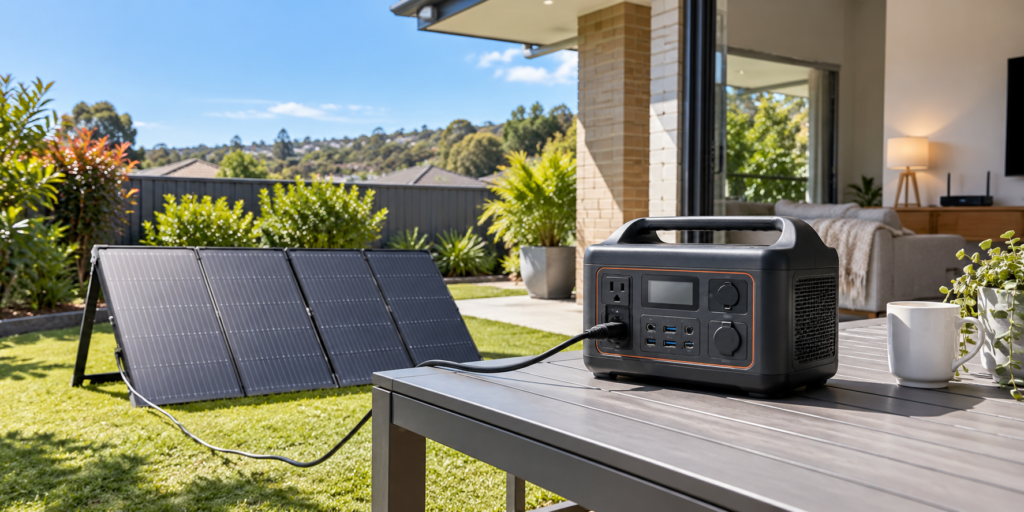
Solar charging can help a compatible portable power station replenish its stored energy during daylight hours.
This can be useful when an outage lasts longer than the battery’s initial charge would support. Instead of relying entirely on mains electricity becoming available again, you may be able to use suitable solar panels to recharge the battery.
However, solar charging is not guaranteed to replace all the energy you use.
The result depends on the rated solar input, panel compatibility, available sunlight, weather, shading, panel orientation and the amount of energy your appliances consume.
A power station that uses more energy than the solar panels can replace each day will gradually run down, even if solar charging is available.
Before relying on solar backup, check the station’s maximum solar input, compatible panel voltage and current limits, charging connections and any restrictions on charging while appliances are connected.
Solar charging should be treated as part of the overall backup plan rather than a guarantee of unlimited electricity.
If you already have rooftop solar, do not assume it will continue supplying your house during a blackout. The installation needs to support backup operation. Our guide, Solar Backup During Power Outages: A Practical Australian Guide, explains why ordinary grid-connected solar may switch off when mains electricity fails.
Noise and Where the Equipment Can Be Used
The location of your backup equipment may determine which option is practical.
Portable power station noise
Portable power stations are generally much quieter than fuel generators because they do not have a running combustion engine.
Some models produce fan noise when charging, operating at higher loads or managing battery temperature. The amount of noise depends on the product and its operating conditions.
For households where people need to sleep, work or maintain a quiet indoor environment, a battery-powered option can be attractive.
It is still important to follow the manufacturer’s instructions about operating temperature, ventilation, moisture protection, charging and placement.
Generator noise and outdoor operation
A fuel generator produces engine noise, which can disturb household members and neighbours. Noise levels differ between conventional generators, inverter generators and other designs.
More importantly, fuel generators create exhaust containing carbon monoxide, a gas that cannot be seen or smelled and can cause fatal poisoning.
Queensland Government guidance states that portable generators must be used outdoors, away from windows and vents, and not inside garages, homes, caravans or other enclosed or partially enclosed areas, even with the doors or windows open.
Read the Queensland Government’s guidance on using generators safely during power outages before operating a fuel-powered generator.
You also need to consider rain, wet surfaces, extension leads, exhaust direction and safe fuel storage. If you cannot provide a suitable outdoor operating location, a conventional portable generator may not be a practical choice.
Upfront Cost and Ongoing Running Costs
The purchase price alone does not tell you which backup option will cost less.
Portable power station costs
The price of a portable power station depends on battery capacity, AC output, battery technology, charging speed, available ports and other features.
A larger battery or higher inverter output can increase the upfront price. Compatible solar panels or expansion batteries may also add to the total cost.
After purchasing a unit, the cost of operating it depends partly on how you recharge it. Mains electricity has a cost, while solar charging can provide an alternative when conditions and equipment allow.
The battery will also age over time. Its usable capacity and performance depend on the battery chemistry, cycle history, storage conditions, temperature and manufacturer guidance.
For a fair comparison, consider the complete system you need rather than comparing only the price of two individual units.
Generator purchase and fuel costs
A generator’s purchase price varies with output, engine type, fuel system, noise performance, features and intended application.
You also need to account for fuel, engine oil where required, servicing, maintenance items, appropriate extension leads and safe fuel storage.
Fuel costs can add up during repeated or extended outages, especially when the generator supplies a substantial load for many hours.
The generator must also be stored and maintained properly so it can be used when needed.
Which is cheaper overall?
There is no universal answer.
A portable power station may be more convenient for occasional outages and modest essential loads, especially when you can recharge it from compatible solar panels. A generator may offer a practical option for sustained output during long outages, provided fuel and safe operation are manageable.
To compare costs, estimate how often you expect to use the equipment, how much energy you need, what fuel or charging will cost and whether extra equipment will be required.
Maintenance and Readiness
Backup equipment is only useful if it is ready to operate when the power fails.
Portable power stations require appropriate charging, storage and battery care. Follow the manual for storage charge levels, temperature limits, inspection, charging connections and any periodic checks recommended by the manufacturer.
Do not use damaged cables, connectors or equipment. If the unit shows signs of damage or abnormal behaviour, follow the manufacturer’s safety advice before using it again.
Generators require more routine attention because they contain an engine and use fuel. Depending on the model, maintenance may include checking engine oil, inspecting filters, servicing components and following the manufacturer’s schedule.
Fuel must be stored safely and used within the manufacturer’s requirements. Before refuelling, switch the generator off and allow it to cool as instructed.
Whichever system you choose, test your backup arrangements before an outage occurs. Make sure you understand how to connect the equipment, which appliances can be supplied safely and how the system will be recharged or refuelled.
Can You Connect a Generator or Power Station to Your Home Wiring?
This is an important safety distinction.
A portable power station is commonly used by plugging compatible appliances directly into its AC outlets or other suitable outputs. Some larger systems offer approved equipment for supplying selected household circuits, but these arrangements depend on the product and installation.
A generator can also supply appliances directly through appropriate connections. However, connecting generator power to fixed household wiring requires a properly designed installation.
Never try to power house wiring by plugging a generator into an ordinary wall socket. This is known as backfeeding and can create a potentially fatal electrocution hazard for utility workers and other people. It can also damage equipment when mains electricity returns.
The Queensland Electrical Safety Office advises that a licensed electrician must install the appropriate changeover equipment when a generator is connected to household wiring.
Read the Electrical Safety Office’s generator safety guidance before planning a generator installation.
Do not improvise connections between a portable power station, a generator and your household circuits. Use only manufacturer-approved equipment and have fixed wiring work performed by a licensed electrician.
Which Is Better for Different Households?
The most suitable option depends on your home, your essential loads and the conditions you expect during a blackout.
For phones, internet and lighting
A portable power station may be sufficient if you mainly need to keep mobile phones, Wi-Fi equipment, a laptop and a few lights operating.
These are generally lower-power loads, although actual consumption and operating time will vary. A suitably sized battery can provide convenient backup without engine noise or fuel handling.
For refrigeration
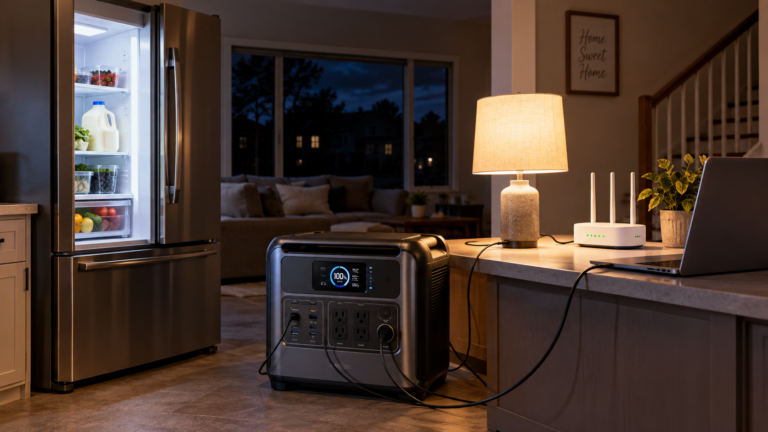
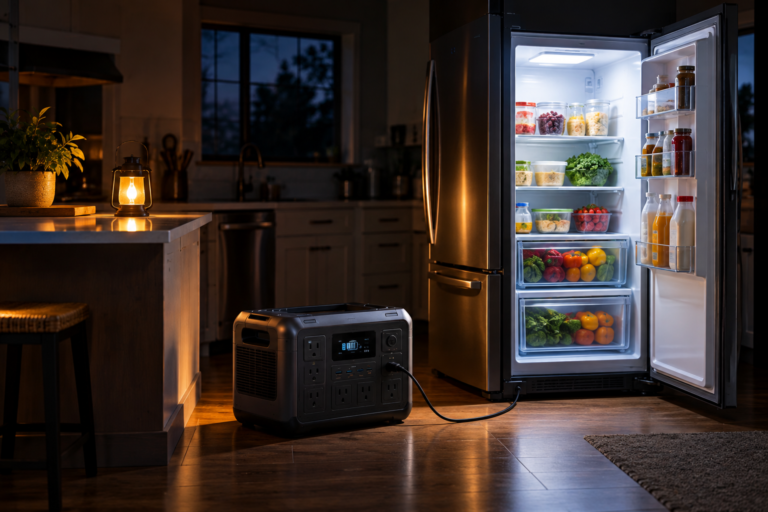
Both options may be able to run a refrigerator if their output characteristics are suitable.
For a portable power station, check the continuous AC output, compressor starting requirements and usable battery capacity. For a generator, check its rated output and ability to handle the refrigerator’s starting load.
In either case, estimate the energy required over the outage and have a plan for longer interruptions.
For extended blackouts
A generator may suit households that need sustained electricity for higher loads and can operate the equipment safely outdoors.
A larger portable power station may also help, particularly if you can recharge it from compatible solar panels or another supported source.
The key is to calculate the amount of energy you will use, how frequently you can replenish it and which appliances truly need to stay on.
For apartments or homes without a suitable outdoor area
A portable power station may be more practical because many models can supply selected appliances indoors when used according to their instructions.
A fuel generator is not suitable for operation inside an apartment, garage or enclosed area. A lack of suitable outdoor space can make a conventional portable generator impractical.
For households with existing rooftop solar
A compatible portable power station with suitable solar charging may provide another way to replenish stored energy during daylight hours.
However, ordinary rooftop solar does not necessarily provide backup during a grid outage. Check whether the existing installation supports backup operation before relying on it.
Can You Use a Portable Power Station and a Generator Together?
In some situations, using both can provide a flexible backup arrangement.
For example, a household might use a portable power station to keep communications equipment, lighting and selected electronics running quietly indoors. A generator could provide additional electricity during a longer outage or recharge the battery if the particular power station supports charging from that generator.
This arrangement may reduce the need to run a generator continuously for small loads. However, whether it is suitable depends on the equipment, electrical compatibility, energy requirements and operating instructions.
Before attempting this arrangement, confirm that the generator’s output is suitable for the power station’s charging input, and observe all relevant manufacturer requirements.
The generator must remain outdoors in a safe operating location. Do not bring it inside to charge the battery, and do not connect either device to fixed household wiring through improvised connections.
Also consider whether operating two systems adds unnecessary expense and complexity. If the battery alone meets your requirements, buying a generator as well may not be worthwhile.
A Practical Checklist for Choosing Backup Power
Before purchasing either option, work through the following questions.
1. Identify your essential appliances
List the devices you want to keep operating during a blackout. Separate essential equipment from appliances you can do without.
2. Check the power requirements
Check each appliance’s rated power and any starting or surge requirement. Add together the wattages of the equipment you expect to operate at the same time.
3. Estimate how long you need backup
Decide whether you need enough power for a short interruption, an evening without electricity or a potentially extended outage.
4. Plan your energy supply
For a portable power station, calculate the required usable battery capacity and determine how you will recharge it. For a generator, consider fuel consumption, safe fuel storage and the expected duration of operation.
5. Check where the equipment can operate
A power station may be convenient indoors, subject to its instructions. A fuel generator must be operated outdoors, away from openings, and protected from unsuitable conditions in accordance with the manufacturer’s instructions.
6. Calculate the total cost
Include the equipment, any required accessories, ongoing energy costs, maintenance and additional charging or fuel arrangements.
7. Check the complete specifications
Compare continuous output, surge capability, battery capacity or generator output, charging options and all relevant operating restrictions. Do not buy solely on advertised battery capacity or peak wattage.
8. Prepare before the next outage
Store the equipment appropriately, understand how it works, check the recommended maintenance and have a safe connection plan ready.
Common Mistakes to Avoid
Choosing by battery capacity alone
A large battery does not guarantee that a portable power station can run an appliance. The continuous output and surge capability must also be sufficient.
Assuming a generator can run every appliance
Generators have output limits too. Add the loads of appliances that will operate simultaneously and allow for starting requirements.
Underestimating the energy needed
A system may run an appliance successfully but not for as long as expected. Estimate runtime and allow for real-world losses and changing demand.
Assuming solar charging will always be enough
Solar production varies with weather, shading, time of day and equipment. A solar-recharged battery may still run down if energy use exceeds recharging.
Operating a generator in an enclosed space
Never run a portable fuel generator indoors, in a garage, in a caravan or in another enclosed or partially enclosed area. Carbon monoxide poisoning can be fatal.
Improvising household electrical connections
Never backfeed household wiring or use unsuitable adapters and connections. Consult a licensed electrician about any fixed-wiring backup arrangement.
Waiting until a blackout to test the equipment
Prepare and test the intended setup beforehand, following manufacturer instructions. A plan that has not been checked may fail when you need it most.
Frequently Asked Questions
Is a portable power station better than a generator for home backup?
A portable power station is often more convenient for quieter backup of selected appliances, especially during shorter outages. A generator may suit longer outages and sustained higher loads when safe outdoor operation and fuel management are practical. The better choice depends on your needs.
Can a portable power station run a refrigerator during a blackout?
Yes, provided its continuous AC output and surge capability meet the refrigerator’s requirements and its usable battery capacity supports the desired runtime. The exact requirements depend on the refrigerator and power station.
Can a generator run continuously during a blackout?
A generator may be able to operate for extended periods, but only within its rated operating limits and maintenance requirements. Fuel, servicing, refuelling intervals and safe operating conditions all need to be considered.
Is a portable power station safe to use indoors?
Many portable power stations can be used indoors according to their manufacturers’ instructions because they do not burn fuel and do not produce engine exhaust at the point of use. Follow all instructions on operating temperature, ventilation, charging, placement and damaged equipment.
Can solar panels keep a portable power station charged during a blackout?
Compatible solar panels may recharge a portable power station during daylight, but actual charging depends on sunlight, weather, panel output, compatibility and energy consumption. Solar charging should not be treated as a guarantee of uninterrupted power.
Can I connect a generator directly to a wall socket?
No. Never plug a generator into a normal household wall socket to supply house wiring. Backfeeding can create serious electrocution hazards. A licensed electrician must install an appropriate, approved connection arrangement for fixed household wiring.
Should I buy both a generator and a portable power station?
Not every household needs both. A combination can be useful when you want quiet battery power for selected equipment as well as a way to supply more power or recharge a compatible battery during a long outage. Compare the additional cost and complexity with your actual backup requirements before purchasing both.
Final Thoughts
Choosing between a portable power station vs generator comes down to how you want to use backup electricity, how much power you need and how long you expect to be without mains electricity.
A portable power station offers convenient battery-powered backup for selected devices and appliances, with the possibility of recharging from compatible solar panels. A fuel generator can provide continuing electrical output while it has fuel, but it brings additional noise, maintenance, fuel-handling and outdoor safety requirements.
Neither option is automatically the right choice for every home.
Start by identifying your essential appliances, checking their electrical requirements and estimating how long you need them to operate. Then compare the complete specifications, operating arrangements and total costs of the systems you are considering.
A well-planned backup system is not necessarily the largest or most powerful model. It is the one that safely meets your household’s actual needs.